

Suicide Prevention for OT, PT, and SLP

Watch or Listen
(Membership required to take quiz and earn CEUs.)
Also available on



Course Quiz
Choose a CEU plan to take this course quiz!
Plans & PricingCourse Introduction
In the United States, approximately 49,000 people die by suicide each year. And, unfortunately, the rate of suicide has increased substantially since 2000, up about 30%.
Suicide remains among the 10 leading causes of death among persons aged 10-64 years and is the second leading cause of death among those aged 10-14 and 25-34.
While these trends are multifactorial, they are particularly distressing because evidence-based approaches to suicide prevention screening and intervention are better established than ever.
Yet confidence and training in these approaches remain too low — even among behavioral health workers. OTs, PTs, and SLPs are uniquely positioned to recognize warning signs through repeated, relationship-based care, but most receive little formal training in suicide prevention.
This course seeks to address that gap. We’ll cover the basics of:
What to watch for
Evidence based screening
Evidence based intervention
And, the role of the team
We’ll anchor our discussion in one of the most comprehensive evidence-based frameworks available: the VA/DoD Clinical Practice Guideline for Assessment and Management of Patients at Risk for Suicide (2024). And we’ll be joined by Christine Weible-Cruz, LCSW, to get practical on what these guidelines look like in frontline care.
If you or someone you know is in crisis, the 988 Suicide & Crisis Lifeline is available 24/7 — call or text 988, or chat at 988lifeline.org. Veterans and service members can press 1 after dialing.
Learning Objectives
You will be able to identify evidence-based approaches to assessing suicide risk.
You will be able to recognize evidence-based brief interventions for suicide prevention.
Agenda
Intro
Discussion
Tell me the story of how you became interested in clinical social work, and about your current practice.
Why do you think it is important for the whole healthcare team (including OTs, PTs, and SLPs) to boost our confidence in suicide prevention?
I want to walk step by step through the parts of the CPG. The guidelines begin with a list of warning signs. What feelings might pop up as a healthcare provider if we see a warning sign?
If we see a warning sign, it seems that we should next ask about suicide. What language can we use to ask this? And, can you speak to Iatrogenic risk (or the fear we might put the idea of suicide in someone’s head?)
An additional step could then be a fuller assessment. There are specific tools that can be employed, but it feels like the goal is to ascertain: is there an immediate risk & can it safely be managed. What can this look like?
If there is an immediate risk, one of the next steps in the conversation would be lethal means safety and do THEY FEEL they can remain safe until therapy or a MD visit is initiated. What can this look like?
Can you tell me about shared decision making, and what can it look like to help the patient initiate a hospital stay if needed?
Part of our goal as allied health professionals is to get the patient to an MD and ultimately someone like you. What evidence-based approaches might you initiate, and what do you want us to know about this pass off?
Part of what makes all of this worrisome to me in a work-setting is actually documenting the process. Any tips for how we logistically capture this process if we are a part of it? How can we use something like SPI to guide our documentation?
Live Q&A
Closing
Supporting Research
Here’s the guideline we’ll focus on: Assessment and Management of Patients at Risk for Suicide (2024) – VA/DOD Clinical Practice Guidelines
Additional Supporting Research
Contact Hours (CEUs/PDUs)
1 Contact Hour. Released online from Aurora, NE.
This course was designed to meet your continuing education requirements
We designed our courses to meet the requirements for “online” and “independent/self-study” courses. To verify the requirements from your specific state (within the U.S.), check out OT Continuing Education Requirements. If you are outside of the United States and don't see requirements for your specific location on that page, please contact us.
OT Potential courses are presented as live webinars, then released on-demand video and audio via the OT Potential Podcast. Attendance in the live webinar will be indicated on your certificate. Learn more about how our courses help meet live webinar requirements, and OT CEU requirements overall.
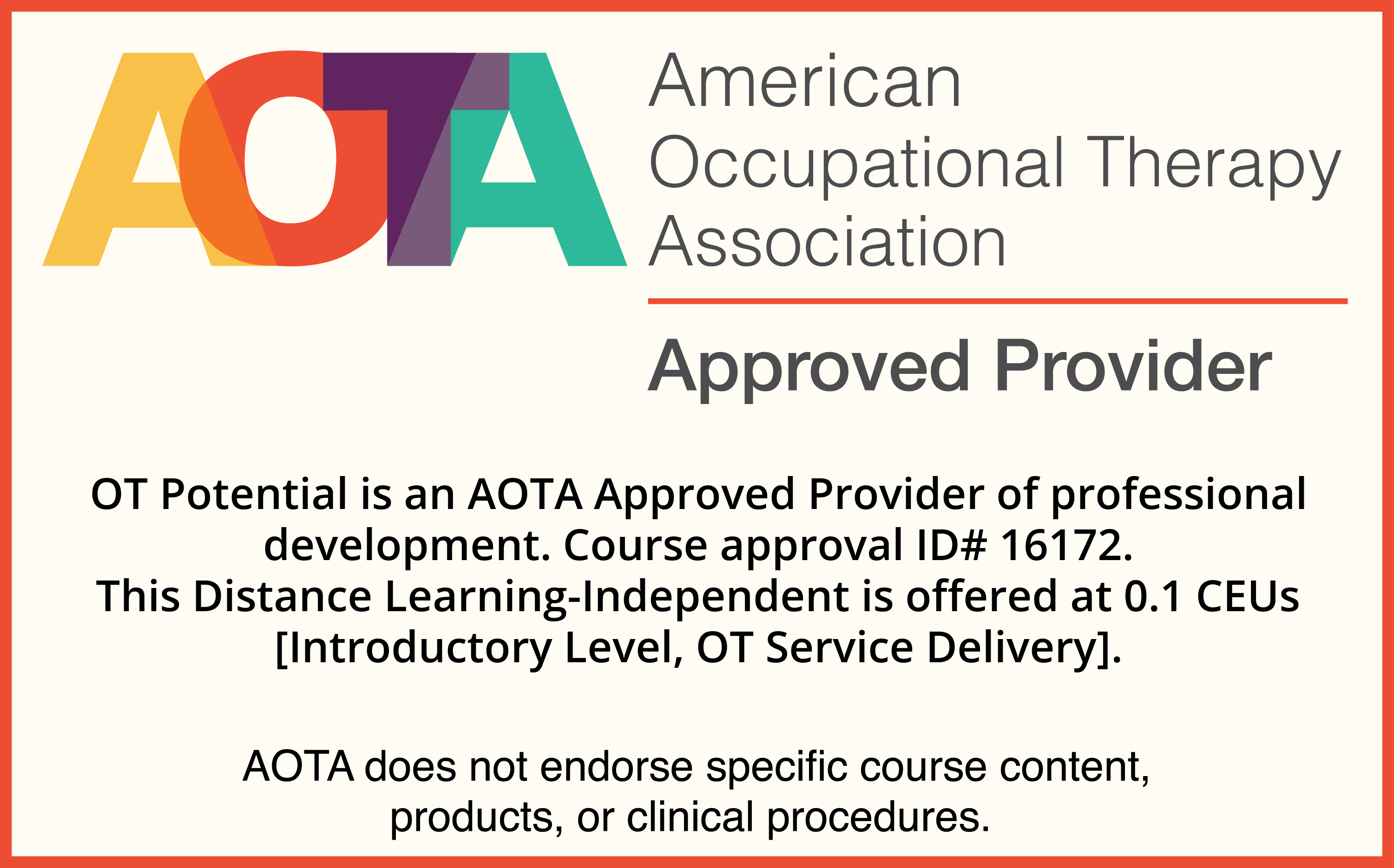
We are proud to be an AOTA Approved Provider and to meet the requirements for your NBCOT renewal.
AOTA Details
AOTA Course ID#: 16172
AOTA CEUs Earned: 0.1
AOTA Delivery Format: Distance Learning-Independent
AOTA Category: OT Service Delivery
AOTA Level: Introductory
NBCOT Details
NBCOT PDUs Earned: 1.25
Instructional Methods, Registration, Special Needs Requests, Cancellation Policy
This course is an independent/self-study course delivered via podcast on one or more of the following platforms: YouTube, Apple Podcasts, Spotify, & Google Play.
If you need accommodations to take this course, please contact us and we will address your needs on an individual basis.
If we cancel a promoted course, event, live stream, or any other paid CEU offering prior to release, and you subscribe explicitly for said offering, you are eligible for a full refund if you did not complete and earn any other CEU quizzes or certificates during your subscription.
If a live webinar is cancelled that you signed up for, our system will automatically generate an email to you and if possible, we will inform you of the rescheduled date. Our most current webinar schedule will be found here.
Audience / Education Level & Course Completion Requirements
Our target audience is therapy professionals who are looking to learn more about this topic. The educational level is introductory. In order to receive a certificate for this course, you must first participate in the podcast/webinar in its entirety. Then, you will need to take the quiz that will accompany the course and earn 75% or higher. If you pass, a PDF certificate will be made available to you via email and download. Quizzes for live (distance learning–interactive) webinars must be completed within 3 days of completing the webinar.
Disclosures
It is the policy of OT Potential to disclose any financial and non-financial interest the provider or instructor may have in a product or service mentioned during an activity. This is to ensure that the audience is made aware of any bias of the speaker.
OT Potential pays guest speakers an honorarium for their participation, either directly or to an institution of the speaker's choosing at their request. We invite guests whose expertise often comes from practices, programs, or building products in their field. Where a speaker has a financial interest in the subject of a course, we disclose it below so you can weigh it for yourself.
OT Potential's interest in this topic: We have no financial stake in this topic.
Speaker interests: Christine Weible-Cruz operates a private psychotherapy practice. She has no financial interest in this topic to disclose.
Speakers
I work with people who want to understand the root of patterns in their lives, not just manage symptoms—those who are curious about themselves, even the parts that feel stuck or contradictory. I support people moving through anxiety, depression, grief, and trauma, as well as those navigating tender life transitions. For couples, I help partners reconnect and feel close again, regardless of relationship structure.
I offer both in-person and virtual sessions for Illinois residents, with the flexibility to work in English or Spanish. I welcome people of all backgrounds, identities, abilities, and life experiences.

Sarah Lyon
OTR/L
Sarah Lyon, OTR/L, is the CEO of OT Potential. Sarah earned her BA from St. Olaf College and her master’s degree in occupational therapy from New York University. Her diverse clinical background spans multiple settings, including critical access, acute trauma, and state inpatient psychiatric hospitals. In 2011, she founded OT Potential to fulfill the industry's need for reliable, high-quality occupational therapy resources and continuing education.
As a recognized content creator, Sarah has collaborated with top healthcare brands like VeryWell Health, WebPT, and MedBridge. She blends her clinical expertise with a talent for creating clear, action-oriented content that empowers practitioners to excel. Passionate about elevating the OT profession, she has been featured on numerous industry podcasts. Sarah ultimately returned to her roots, running OT Potential and raising her family in her hometown of Aurora, Nebraska.
More Courses

Rehab Tech Abandonment - Live Webinar
Christopher Gaskins, PhD, OTR/L, CSRS

Approved

OT as Mental Health Providers - Live Webinar
Halley Read, PhD, OTR/L, FAOTA
Approved

Marketing Your Therapy Practice - Live Webinar
Erica Stevens, MOTR/L, CLT, CHC, CYT
Approved

Risk Factors for Cognitive Decline - Live Webinar
Ganesh M. Babulal, PhD, OTD, MSCI, MOT, OTR/L
Approved