

OT as Mental Health Providers

Halley Read, PhD, OTR/L, FAOTA

Sarah Lyon, OTR/L
Watch or Listen
(Membership required to take quiz and earn CEUs.)
Also available on



Course Quiz
Choose a CEU plan to take this course quiz!
Plans & PricingCourse Introduction
For as long as I've been an OT, I've been hearing about occupational therapy's advocacy to be recognized as behavioral health providers.
This is frankly a little confusing, since OT has deep roots in mental health care — and many of us became OT professionals because of the unique way the profession holistically considers mental health and physical health, and how the two intersect in everyday function.
Things honestly become even more confusing when you start to dig into what exactly it means to be recognized as a behavioral health provider. What doors does that open to us? What is the current patchwork of states — and what is our desired future?
There is no better person to help us speak to these questions than Halley Read. Halley is the lead author on "Occupational Therapy: A Potential Solution to the Behavioral Health Workforce Shortage," published in Psychiatric Services in 2024.
Which gets at exactly the right question: why are we limiting the mental health workforce, when mental health workers are so desperately needed?
This course is intended for OT professionals, to help us understand this situation — but also for our fellow members of the healthcare team, to understand what OT can contribute and what policy changes would let us work in our full scope.
Learning Objectives
Healthcare team members will be able to identify how OT being recognized at the state level as qualified mental health providers, opens more access to clients.
You will be able to recognize at the federal level how OT being recognized as a mental health provider would open more access to care to clients.
Agenda
Intro (5 minutes)
Discussion (40 minutes)
Tell me about your journey into mental health OT and then advocacy.
How did this paper come together and what stands out to you now?
What has changed since this paper was written?
How do OTs uniquely contribute to the mental health team?
Do we have the evidence based and scope of practice needed to move into this space?
What are concrete stories you know of OTs making differences in their communities?
Tell me about becoming a qualified mental health provider at the state level. What door does this open to us?
How would being recognized federally as mental health providers change our ability to serve clients?
What does the OT in mental health movement look like globally? Are the US leaders or laggards?
How can OTs and other health care providers get involved in this movement?
Live Q&A (5-10 min)
Closing (5 min)
Supporting Research
Contact Hours (CEUs/PDUs)
1 Contact Hour. Released online from Aurora, NE.
This course was designed to meet your continuing education requirements
We designed our courses to meet the requirements for “online” and “independent/self-study” courses. To verify the requirements from your specific state (within the U.S.), check out OT Continuing Education Requirements. If you are outside of the United States and don't see requirements for your specific location on that page, please contact us.
OT Potential courses are presented as live webinars, then released on-demand video and audio via the OT Potential Podcast. Attendance in the live webinar will be indicated on your certificate. Learn more about how our courses help meet live webinar requirements, and OT CEU requirements overall.
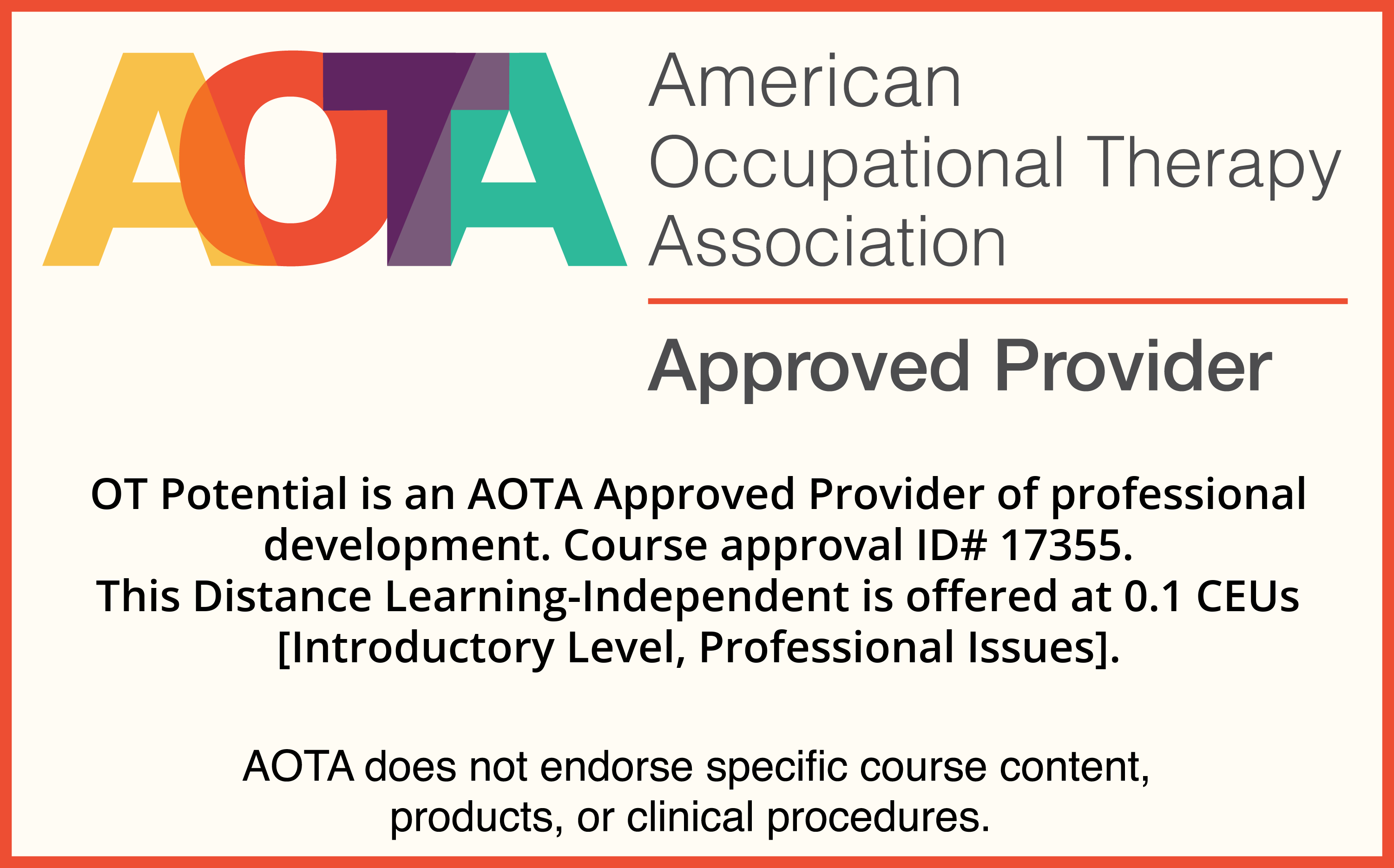
We are proud to be an AOTA Approved Provider and to meet the requirements for your NBCOT renewal.
AOTA Details
AOTA Course ID#: 17355
AOTA CEUs Earned: 0.1
AOTA Delivery Format: Distance Learning-Independent
AOTA Category: Professional Issues
AOTA Level: Introductory
NBCOT Details
NBCOT PDUs Earned: 1.25
Instructional Methods, Registration, Special Needs Requests, Cancellation Policy
This course is an independent/self-study course delivered via podcast on one or more of the following platforms: YouTube, Apple Podcasts, Spotify, & Google Play.
If you need accommodations to take this course, please contact us and we will address your needs on an individual basis.
If we cancel a promoted course, event, live stream, or any other paid CEU offering prior to release, and you subscribe explicitly for said offering, you are eligible for a full refund if you did not complete and earn any other CEU quizzes or certificates during your subscription.
If a live webinar is cancelled that you signed up for, our system will automatically generate an email to you and if possible, we will inform you of the rescheduled date. Our most current webinar schedule will be found here.
Audience / Education Level & Course Completion Requirements
Our target audience is therapy professionals who are looking to learn more about this topic. The educational level is introductory. In order to receive a certificate for this course, you must first participate in the podcast/webinar in its entirety. Then, you will need to take the quiz that will accompany the course and earn 75% or higher. If you pass, a PDF certificate will be made available to you via email and download. Quizzes for live (distance learning–interactive) webinars must be completed within 3 days of completing the webinar.
Disclosures
It is the policy of OT Potential to disclose any financial and non-financial interest the provider or instructor may have in a product or service mentioned during an activity. This is to ensure that the audience is made aware of any bias of the speaker.
OT Potential pays guest speakers an honorarium for their participation, either directly or to an institution of the speaker's choosing at their request. We invite guests whose expertise often comes from practices, programs, or building products in their field. Where a speaker has a financial interest in the subject of a course, we disclose it below so you can weigh it for yourself.
OT Potential's interest in this topic: We have no financial stake in this topic.
Speaker interests: Halley Read has no financial interest in this topic to disclose. She is lead author of the primary journal article explored in this course, Occupational Therapy: A Potential Solution to the Behavioral Health Workforce Shortage, and serves on the Board of Directors of the American Occupational Therapy Association as Speaker of the Representative Assembly.
Speakers
Halley Read
PhD, OTR/L, FAOTA
Halley Read is a mental wellness occupational therapist, servant leader, and social change agent based in Portland, Oregon. As a mental health occupational therapist, Halley has worked with people across the lifespan living with serious mental health challenges. Now as a passionate educator and researcher in full-time academia, her work in research and capstone coordination is driven by a passion for equality, Recovery, human rights and advocacy. Mental health is a community and public health imperative.
With a PhD in Translational Health Sciences, Halley uses knowledge translation, implementation science and the OT scope to understand how we bridge the gaps between recovery and the care we deliver in mental health care in sustainable and cost-conscious ways.
Sarah Lyon, OTR/L, is the CEO of OT Potential. Sarah earned her BA from St. Olaf College and her master’s degree in occupational therapy from New York University. Her diverse clinical background spans multiple settings, including critical access, acute trauma, and state inpatient psychiatric hospitals. In 2011, she founded OT Potential to fulfill the industry's need for reliable, high-quality occupational therapy resources and continuing education.
As a recognized content creator, Sarah has collaborated with top healthcare brands like VeryWell Health, WebPT, and MedBridge. She blends her clinical expertise with a talent for creating clear, action-oriented content that empowers practitioners to excel. Passionate about elevating the OT profession, she has been featured on numerous industry podcasts. Sarah ultimately returned to her roots, running OT Potential and raising her family in her hometown of Aurora, Nebraska.
More Courses

Risk Factors for Cognitive Decline - Live Webinar
Ganesh M. Babulal, PhD, OTD, MSCI, MOT, OTR/L

Approved

Motivational Interviewing - Live Webinar
Sabina Khan, PhD, OTD, OTR/L
Approved

Interprofessional Education - Live Webinar
Michael Sy, PhD, MHPEd, OTRP
Approved

Early Psychosis Care - Live Webinar
Nuriya Hefron
Approved