

OT, Nitrates, and Cancer Prevention

Jesse E. Bell, PhD
Watch or Listen
(Membership required to take quiz and earn CEUs.)
Also available on



Course Quiz
Choose a CEU plan to take this course quiz!
Plans & PricingCourse Introduction
It’s no secret that I believe occupation therapy is entering its prevention era.
We are starting to leverage our skillset not after a terrible health incident has occurred, but at the first sign of trouble.
As I imagine this not-too-distant reality, there is one deeply personal area that I am so eager to see us shift our energy toward:
Cancer prevention.
Across the healthcare community, we are learning more and more about the specific lifestyle and environmental factors that put people at a higher risk for cancer. Case in point: My own county in rural Nebraska, where above-average pediatric cancer rates have been associated with high levels of nitrates in our water.
On this live webinar and podcast course, we are lucky to be joined by Dr. Jesse E. Bell, one of the world’s leading experts on water and human health and the Claire M. Hubbard Professor of Water, Climate, and Health in the University of Nebraska Medical Center’s Department of Environmental, Agricultural, and Occupational Health.
Dr. Bell—who also is the author of the paper we will discuss during this episode—will help us understand where the science stands on the connection between nitrates in water and multiple health conditions. We’ll talk through ways the medical community can provide education on these risks—as well as the simple solutions OTs could potentially bring to high-risk families to help address this basic ADL safety concern.
This episode is meant to highlight the cutting edge of what’s becoming possible—where new large datasets on environmental health risks converge with new opportunities in value-based care to create pathways for OTs to intervene earlier than we ever thought possible.
Learning Objectives
You will recognize how you as an OT could help assess the critical occupation of drinking safety in rural areas.
You will be able to identify who you can educate and intervene around the bADL of drinking safely in rural areas.
Agenda
Intro
Discussion on practical implications for OTs
How did you become interested in nitrates and human health?
Why do you think it is important for health professionals, like OTs, to learn more about environmental risks and health?
The article we reviewed was published in 2022, what have you learned about nitrates and human health since?
What are the biggest questions you have lingering about nitrates and human health?
It seems like even though the problem is very complex- the solution is simple: test your water and if your levels are either do not drink it or high install an R.O. (which the state of Nebraska supports through various programs.) Would you agree with this, and do you see the medical community having a role in supporting this process?
There’s a great line from the American Academy of Pediatrics on providers’s role in educating on water safety. What have you found to be the barriers so far?
I see a future where a doctor identifies a family that is at risk of high-nitrates and makes a referral to OT, so they can do the patient education and follow-through on testing. (I can even see a data set being integrated into our EMRs, where doctors are flagged when patients live in high-nitrate areas…) Is this the direction we should be heading?
What information would you include in patient handouts about OT education and intervention?
I’m working with our local health district, where we encourage MDs to refer to an OT for this education. Do you have any advice for us?
Where do you see this conversation on nitrates and human health heading in the next 5 years?
Closing
Supporting Research
Primary Journal Article Explored: Geospatial Distribution of Age-Adjusted Incidence of theThree Major Types of Pediatric Cancers and Waterborne Agrichemicals in Nebraska
Drinking-water nitrate and cancer risk: A systematic review and meta-analysis
Occupational Therapy in Prevention and Wellness: Retaining Relevance in a New Health Care World
For other important posts about this topic, please see Nitrates in Water and Health Risks and an Example Patient Journey with Associated ICD-10 and CPT codes.
Contact Hours (CEUs/PDUs)
1 Contact Hour. Released online from Aurora, NE.
This course was designed to meet your continuing education requirements
We designed our courses to meet the requirements for “online” and “independent/self-study” courses. To verify the requirements from your specific state (within the U.S.), check out OT Continuing Education Requirements. If you are outside of the United States and don't see requirements for your specific location on that page, please contact us.
OT Potential courses are presented as live webinars, then released on-demand video and audio via the OT Potential Podcast. Attendance in the live webinar will be indicated on your certificate. Learn more about how our courses help meet live webinar requirements, and OT CEU requirements overall.
We are proud to be an AOTA Approved Provider and to meet the requirements for your NBCOT renewal.
AOTA Details
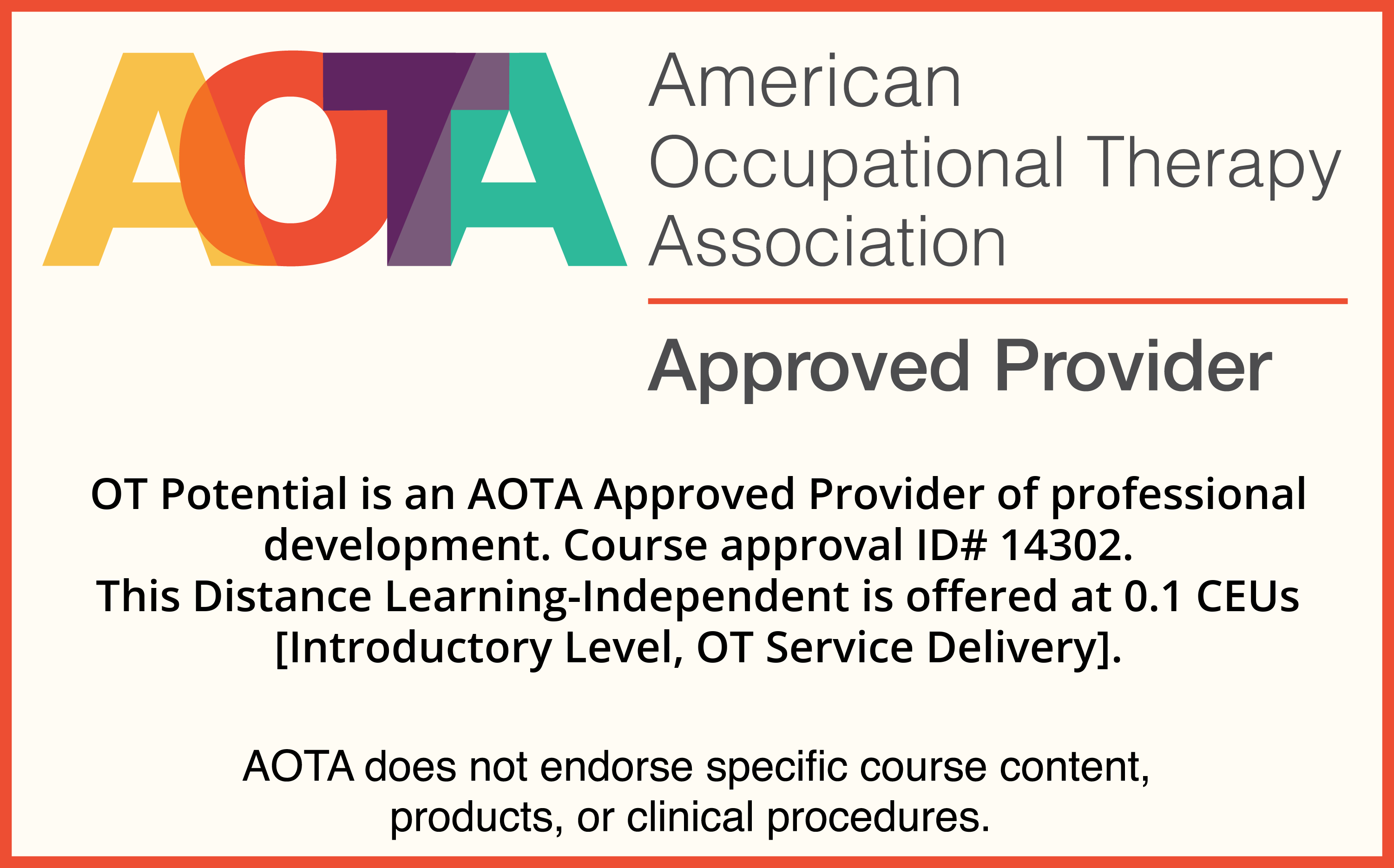
AOTA Course ID#: 14302
AOTA CEUs Earned: 0.1
AOTA Delivery Format: Distance Learning-Independent
AOTA Category: OT Service Delivery
AOTA Level: Introductory
NBCOT Details
NBCOT PDUs Earned: 1.25
Instructional Methods, Registration, Special Needs Requests, Cancellation Policy
This course is an independent/self-study course delivered via podcast on one or more of the following platforms: YouTube, Apple Podcasts, Spotify, & Google Play.
If you need accommodations to take this course, please contact us and we will address your needs on an individual basis.
If we cancel a promoted course, event, live stream, or any other paid CEU offering prior to release, and you subscribe explicitly for said offering, you are eligible for a full refund if you did not complete and earn any other CEU quizzes or certificates during your subscription.
If a live webinar is cancelled that you signed up for, our system will automatically generate an email to you and if possible, we will inform you of the rescheduled date. Our most current webinar schedule will be found here.
Audience / Education Level & Course Completion Requirements
Our target audience is therapy professionals who are looking to learn more about this topic. The educational level is introductory. In order to receive a certificate for this course, you must first participate in the podcast/webinar in its entirety. Then, you will need to take the quiz that will accompany the course and earn 75% or higher. If you pass, a PDF certificate will be made available to you via email and download. Quizzes for live (distance learning–interactive) webinars must be completed within 3 days of completing the webinar.
Disclosures
It is the policy of OT Potential to disclose any financial and non-financial interest the provider or instructor may have in a product or service mentioned during an activity. This is to ensure that the audience is made aware of any bias of the speaker.
OT Potential pays guest speakers an honorarium for their participation, either directly or to an institution of the speaker's choosing at their request. We invite guests whose expertise often comes from practices, programs, or building products in their field. Where a speaker has a financial interest in the subject of a course, we disclose it below so you can weigh it for yourself.
OT Potential's interest in this topic: We have no financial stake in this topic and no relationship with any water testing or filtration company.
Speaker interests: Jesse Bell is an author of the primary research article examined in this course. He has no financial interest in this topic to disclose.
Speakers
Jesse E. Bell
PhD

Sarah Lyon
OTR/L
Sarah Lyon, OTR/L, is the CEO of OT Potential. Sarah earned her BA from St. Olaf College and her master’s degree in occupational therapy from New York University. Her diverse clinical background spans multiple settings, including critical access, acute trauma, and state inpatient psychiatric hospitals. In 2011, she founded OT Potential to fulfill the industry's need for reliable, high-quality occupational therapy resources and continuing education.
As a recognized content creator, Sarah has collaborated with top healthcare brands like VeryWell Health, WebPT, and MedBridge. She blends her clinical expertise with a talent for creating clear, action-oriented content that empowers practitioners to excel. Passionate about elevating the OT profession, she has been featured on numerous industry podcasts. Sarah ultimately returned to her roots, running OT Potential and raising her family in her hometown of Aurora, Nebraska.
More Courses

Marketing Your Therapy Practice - Live Webinar
Erica Stevens, MOTR/L, CLT, CHC, CYT

Approved

Risk Factors for Cognitive Decline - Live Webinar
Ganesh M. Babulal, PhD, OTD, MSCI, MOT, OTR/L
Approved

Motivational Interviewing - Live Webinar
Sabina Khan, PhD, OTD, OTR/L
Approved

Interprofessional Education - Live Webinar
Michael Sy, PhD, MHPEd, OTRP
Approved

