

Perinatal Pelvic Floor Therapy
Watch or Listen
(Membership required to take quiz and earn CEUs.)
Also available on



Course Quiz
Choose a CEU plan to take this course quiz!
Plans & PricingCourse Introduction
The number of OT’s providing perinatal care is on the rise.
Which is exciting…and necessary.
There remain so many gaps in the care of new and expecting moms, among which is treating incontinence.
As we’ll see in our featured journal article, a staggering percentage of women experience incontinence postnatally, despite the known effectiveness of pelvic floor muscle training as a treatment. The article specifically explores the cost effectiveness of different models of pelvic floor therapy.
The main takeaway?
It is more efficient to offer services to prevent incontinence during pregnancy than to provide treatment services to manage incontinence postnatally—and that group-based treatment can be a cost-effective way to do it.
After we break down the article, we’re excited to explore all of this further with pelvic floor occupational therapist, Kyrsten Spurrier, owner of the Perinatal Pelvis. This episode will be hosted by Carlin Reaume of Supported Mama.
Supplemental Pelvic Floor Therapy Materials
Learning Objectives
You will be able to identify three clinically effective models of care to address urinary incontinence.
You will be able to recognize the most cost-effective model of service provision for pelvic floor muscle training.
Agenda
Intro
Breakdown and analysis of journal article
Intro to Perinatal Pelvic Floor Therapy
OT Potential Podcast Intro
Urinary and Fecal Incontinence Postpartum
Treatment Options
Intent of this research
Research Methods
Research Results
Discussion
Discussion on practical implications for OTs
Intro to Kyrsten
The Perinatal Pelvis
Impressions of this Article
Holistic Treatment Approach
Group-based Offerings
Memorable Client Story
Biggest Lesson Learned
What Does Success Mean
Supports for OTs to Start in Pelvic Floor Therapy
Ideal Vision for OT Perinatal Care
Supporting Research
Primary
Additional
Contact Hours (CEUs/PDUs)
1 Contact Hour. Released online from Aurora, NE.
This course was designed to meet your continuing education requirements
We designed our courses to meet the requirements for “online” and “independent/self-study” courses. To verify the requirements from your specific state (within the U.S.), check out OT Continuing Education Requirements. If you are outside of the United States and don't see requirements for your specific location on that page, please contact us.
OT Potential courses are presented as live webinars, then released on-demand video and audio via the OT Potential Podcast. Attendance in the live webinar will be indicated on your certificate. Learn more about how our courses help meet live webinar requirements, and OT CEU requirements overall.
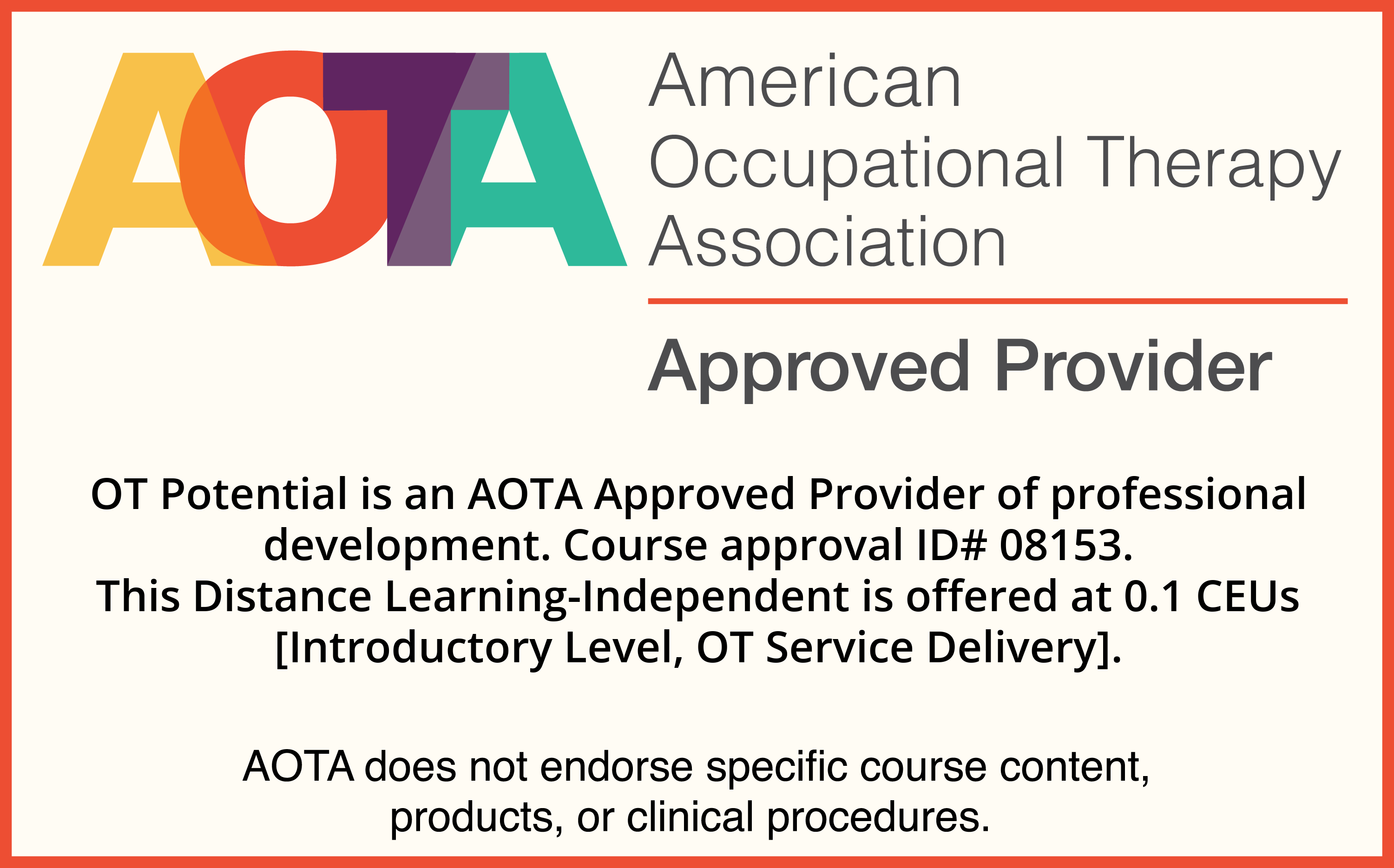
We are proud to be an AOTA Approved Provider and to meet the requirements for your NBCOT renewal.
AOTA Details
AOTA Course ID#: 08153
AOTA CEUs Earned: 0.1
AOTA Delivery Format: Distance Learning-Independent
AOTA Category: OT Service Delivery
AOTA Level: Introductory
NBCOT Details
NBCOT PDUs Earned: 1.25
Instructional Methods, Registration, Special Needs Requests, Cancellation Policy
This course is an independent/self-study course delivered via podcast on one or more of the following platforms: YouTube, Apple Podcasts, Spotify, & Google Play.
If you need accommodations to take this course, please contact us and we will address your needs on an individual basis.
If we cancel a promoted course, event, live stream, or any other paid CEU offering prior to release, and you subscribe explicitly for said offering, you are eligible for a full refund if you did not complete and earn any other CEU quizzes or certificates during your subscription.
If a live webinar is cancelled that you signed up for, our system will automatically generate an email to you and if possible, we will inform you of the rescheduled date. Our most current webinar schedule will be found here.
Audience / Education Level & Course Completion Requirements
Our target audience is therapy professionals who are looking to learn more about this topic. The educational level is introductory. In order to receive a certificate for this course, you must first participate in the podcast/webinar in its entirety. Then, you will need to take the quiz that will accompany the course and earn 75% or higher. If you pass, a PDF certificate will be made available to you via email and download. Quizzes for live (distance learning–interactive) webinars must be completed within 3 days of completing the webinar.
Disclosures
It is the policy of OT Potential to disclose any financial and non-financial interest the provider or instructor may have in a product or service mentioned during an activity. This is to ensure that the audience is made aware of any bias of the speaker.
OT Potential pays guest speakers an honorarium for their participation, either directly or to an institution of the speaker's choosing at their request. We invite guests whose expertise often comes from practices, programs, or building products in their field. Where a speaker has a financial interest in the subject of a course, we disclose it below so you can weigh it for yourself.
OT Potential's interest in this topic: We have no financial stake in this topic.
Speaker interests: Kyrsten Spurrier owns The Perinatal Pelvis, a pelvic health practice that provides the services discussed in this course.
Carlin Reaume, who hosted this episode, owns Supported Mama, a pelvic floor therapy practice.
Speakers


Dr. Carlin Reaume is a pelvic floor therapist in Sacramento, California.
Carlin has more than 15 years of experience as a therapist and educator. Utilizing her clinical expertise in Lifestyle Redesign®, she has focused her career on expanding occupational therapy’s role in non-traditional and emerging practice areas including workplace wellness, college student health, and maternal health.She holds specialty certifications in Perinatal Mental Health (PMH-C) through Postpartum Support International and Pregnancy & Postpartum Corrective Exercise (PCES) through Core Exercise Solutions. Dr. Reaume is also a Registered Yoga Teacher (RYT-200), a certified postpartum doula through Cornerstone Birthwork Training, and a graduate of Loyola Marymount University’s Yoga Therapy RX Certificate Program.
Carlin launched Supported Mama: Pelvic Floor Therapy in 2020 as a way to provide holistic support for women on the journey before, during, and after pregnancy. You can book a visit here.
Dr. Reaume graduated from the University of Southern California (USC) with both her Master of Arts and Doctoral degrees in Occupational Therapy. She also completed her Master of Arts in Education from Pepperdine University. She has presented her work both nationally and internationally, as well as held leadership positions on the Board of Directors for the Occupational Therapy Association of California. Dr. Reaume currently serves as Assistant Clinical Professor for the Doctor of Occupational Therapy Program at the University of the Pacific in Sacramento, California.
More Courses

Risk Factors for Cognitive Decline - Live Webinar
Ganesh M. Babulal, PhD, OTD, MSCI, MOT, OTR/L

Approved

Motivational Interviewing - Live Webinar
Sabina Khan, PhD, OTD, OTR/L
Approved

Interprofessional Education - Live Webinar
Michael Sy, PhD, MHPEd, OTRP
Approved

Early Psychosis Care - Live Webinar
Nuriya Hefron
Approved