

Grip Strength as a Vital Sign
Watch or Listen
(Membership required to take quiz and earn CEUs.)
Also available on



Course Quiz
Choose a CEU plan to take this course quiz!
Plans & PricingCourse Introduction
However you’re thinking about grip strength, I’m betting it isn’t broad enough.
Grip strength is NOT just about hand strength.
It is NOT just an indicator of upper body strength.
It is NOT even just about overall strength.
Grip strength is associated with:
mortality
psychological health
functional disabilities
hospitalization
and more!
The article we are reviewing today urges us to consider grip strength as a vital sign, because this simple measurement is actually an indicator of overall well-being. And, I believe it is a metric every therapist should be paying attention to with virtually every patient.
After we review this article, we will welcome to the podcast Gabriella Francis, OTR/L, ATC. Gabby is the CEO of Squegg, a grip strength health tech company. Through this role, she has been immersed in the science of grip strength—and we are excited to chat with her about the practical implications of this new science for occupational therapy professionals and for our healthcare system at large.
Learning Objectives
You will recognize the associations between grip strength and occupational health.
You will be able to identify important nuances to accurately assessing grip strength.
Agenda
Intro
Breakdown and analysis of journal article
Discussion on practical implications for OTs
Can you tell me how you became the CEO of a health tech company?
Can you tell me the basics of Squegg and your role?
What did you think of this paper?
Do you know any stories of MDs that track grip strength as a vital sign, and refer to therapy based on it?
What do you see as the value of tracking grip strength for ALL OT patients?
What considerations do you weigh when it comes to procedures for testing?
What considerations do you weigh when comparing to our current normative data?
What have you learned about improving grip strength?
What do you see on the horizon for grip strength?
Supporting Research
Primary
Additional
Contact Hours (CEUs/PDUs)
1 Contact Hour. Released online from Aurora, NE.
This course was designed to meet your continuing education requirements
We designed our courses to meet the requirements for “online” and “independent/self-study” courses. To verify the requirements from your specific state (within the U.S.), check out OT Continuing Education Requirements. If you are outside of the United States and don't see requirements for your specific location on that page, please contact us.
OT Potential courses are presented as live webinars, then released on-demand video and audio via the OT Potential Podcast. Attendance in the live webinar will be indicated on your certificate. Learn more about how our courses help meet live webinar requirements, and OT CEU requirements overall.
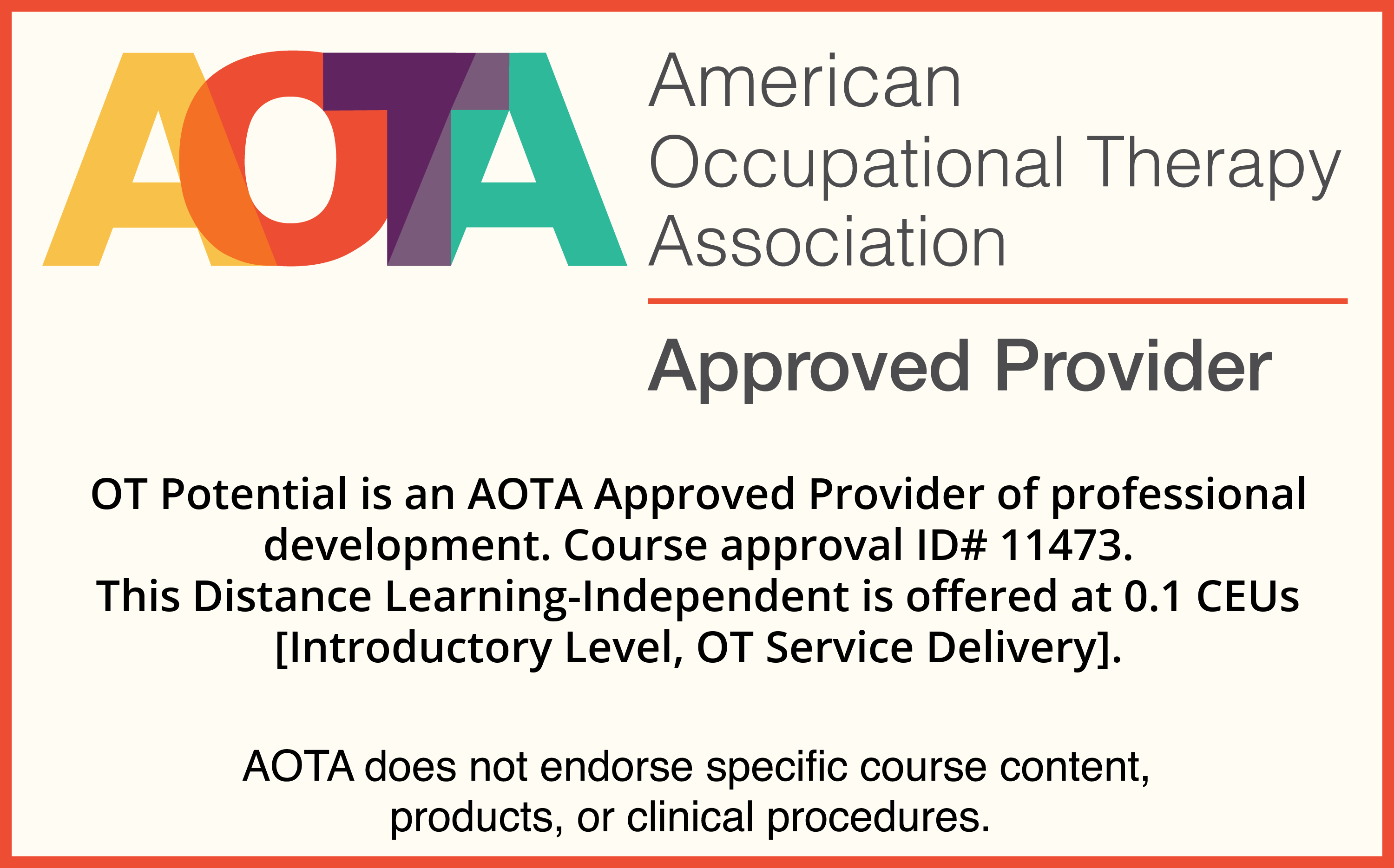
We are proud to be an AOTA Approved Provider and to meet the requirements for your NBCOT renewal.
AOTA Details
AOTA Course ID#: 11473
AOTA CEUs Earned: 0.1
AOTA Delivery Format: Distance Learning-Independent
AOTA Category: OT Service Delivery
AOTA Level: Introductory
NBCOT Details
NBCOT PDUs Earned: 1.25
Instructional Methods, Registration, Special Needs Requests, Cancellation Policy
This course is an independent/self-study course delivered via podcast on one or more of the following platforms: YouTube, Apple Podcasts, Spotify, & Google Play.
If you need accommodations to take this course, please contact us and we will address your needs on an individual basis.
If we cancel a promoted course, event, live stream, or any other paid CEU offering prior to release, and you subscribe explicitly for said offering, you are eligible for a full refund if you did not complete and earn any other CEU quizzes or certificates during your subscription.
If a live webinar is cancelled that you signed up for, our system will automatically generate an email to you and if possible, we will inform you of the rescheduled date. Our most current webinar schedule will be found here.
Audience / Education Level & Course Completion Requirements
Our target audience is therapy professionals who are looking to learn more about this topic. The educational level is introductory. In order to receive a certificate for this course, you must first participate in the podcast/webinar in its entirety. Then, you will need to take the quiz that will accompany the course and earn 75% or higher. If you pass, a PDF certificate will be made available to you via email and download. Quizzes for live (distance learning–interactive) webinars must be completed within 3 days of completing the webinar.
Disclosures
It is the policy of OT Potential to disclose any financial and non-financial interest the provider or instructor may have in a product or service mentioned during an activity. This is to ensure that the audience is made aware of any bias of the speaker.
OT Potential pays guest speakers an honorarium for their participation, either directly or to an institution of the speaker's choosing at their request. We invite guests whose expertise often comes from practices, programs, or building products in their field. Where a speaker has a financial interest in the subject of a course, we disclose it below so you can weigh it for yourself.
OT Potential's interest in this topic: We have no financial stake in this topic.
Speaker interests: Gabriella Francis is CEO of Squegg, which makes a grip strength measurement device.
Speakers

Hi, my name is Gabriella Francis, I use she/her pronouns, and I am a certified and licensed Occupational Therapist practitioner in the state of NY. I completed my Master's from NYU's OT program and am currently working on my post-professional doctorate at NYU with a clinical competence area of expanding the OT's role in designing, and developing assistive technology (AT). I love providing patient care-PD at NYU Langone Rusk Rehabilitation on a medically complex adult inpatient unit. My passions also align with advocacy, accessibility, and usability, for all, as I enter the space of innovation and product design as a subject matter expert and CEO. I am on the product development team at Level the Curve, a disability led company, to help design and develop AT for individuals with various abilities, and I am also the CEO of Squegg (think squeeze +egg)!
I am passionate about breaking down traditional power constructs, empowering users as the experts of their own lived experiences and creatively collaborating to make products that enable individuals to engage and participate in meaningful activities. I am truly excited to see where my career path takes me as the worlds of healthcare and technology merge.

Sarah Lyon, OTR/L, is the CEO of OT Potential. Sarah earned her BA from St. Olaf College and her master’s degree in occupational therapy from New York University. Her diverse clinical background spans multiple settings, including critical access, acute trauma, and state inpatient psychiatric hospitals. In 2011, she founded OT Potential to fulfill the industry's need for reliable, high-quality occupational therapy resources and continuing education.
As a recognized content creator, Sarah has collaborated with top healthcare brands like VeryWell Health, WebPT, and MedBridge. She blends her clinical expertise with a talent for creating clear, action-oriented content that empowers practitioners to excel. Passionate about elevating the OT profession, she has been featured on numerous industry podcasts. Sarah ultimately returned to her roots, running OT Potential and raising her family in her hometown of Aurora, Nebraska.