

Risk Factors for Cognitive Decline
Watch or Listen
(Membership required to take quiz and earn CEUs.)
Also available on



Course Quiz
Choose a CEU plan to take this course quiz!
Plans & PricingCourse Introduction
As we've covered on the podcast, the world is heading toward a dementia crisis. The number of people living with dementia is projected to nearly triple by 2050, and low- and middle-income countries will be hit hardest.
But there is real hope for changing that trajectory: prevention.
The 2024 Lancet Commission estimates that nearly half of dementia cases could be prevented or delayed by addressing 14 modifiable risk factors, including hearing loss, hypertension, physical inactivity, and social isolation. And our guest's research points to something striking: nearly half of individual differences in Alzheimer's risk may be attributable to environmental influences, and his own study found that walkability, green space, and light pollution were linked to cognitive performance regardless of biomarker status.
In this course, we'll talk with Ganesh Babulal, PhD, OTD, MSCI, MOT, OTR/L, FAOTA, about addressing those risk factors, recognizing cognitive decline early, and whether early intervention can slow, or in some cases even reverse, decline.
We'll close with a vision for a team approach to care, where public data on environmental risk is synced into the EMR, physicians recognize risk earlier, and a therapy referral helps mitigate that risk before problems arise.
Learning Objectives
You will be able to identify assessment options for catching early cognitive decline that can be utilized by therapy professionals.
You will be able to recognize modifiable and environmental risk factors for cognitive decline that therapy professionals can address through intervention.
You will be able to recognize how a physician's role in identifying dementia risk complements the therapy professional's contribution to early assessment and risk reduction.
Agenda
Tell me your journey to researching cognitive decline.
Let’s start with some foundational knowledge. What is normal aging? What is pre-clinical cognitive decline and early cognitive decline? (And, what are the other stages?)
How can we capture the changes in the clinic?
If we catch cognitive decline early is there any hope of slowing or reversing it? Will it lead to Alzheimer's?
Why is it important for therapists to understand the risk factors of cognitive decline?
Explain what you’ve learned about the environmental influences on cognitive decline.
Can you walk me through each result in your paper:
Walkability, green space, and tree canopy were significantly associated with better cognitive performance, while light pollution negatively impacted cognition. Biomarker positivity was not a significant predictor.
How can you see therapists using this information?
How could we present this information along with the lifestyle modifications like Life’s Essential 8 (AHA).
What role could you see therapists playing in prevention of dementia?
Supporting Research
Contact Hours (CEUs/PDUs)
1 Contact Hour. Released online from Aurora, NE.
This course was designed to meet your continuing education requirements
We designed our courses to meet the requirements for “online” and “independent/self-study” courses. To verify the requirements from your specific state (within the U.S.), check out OT Continuing Education Requirements. If you are outside of the United States and don't see requirements for your specific location on that page, please contact us.
OT Potential courses are presented as live webinars, then released on-demand video and audio via the OT Potential Podcast. Attendance in the live webinar will be indicated on your certificate. Learn more about how our courses help meet live webinar requirements, and OT CEU requirements overall.
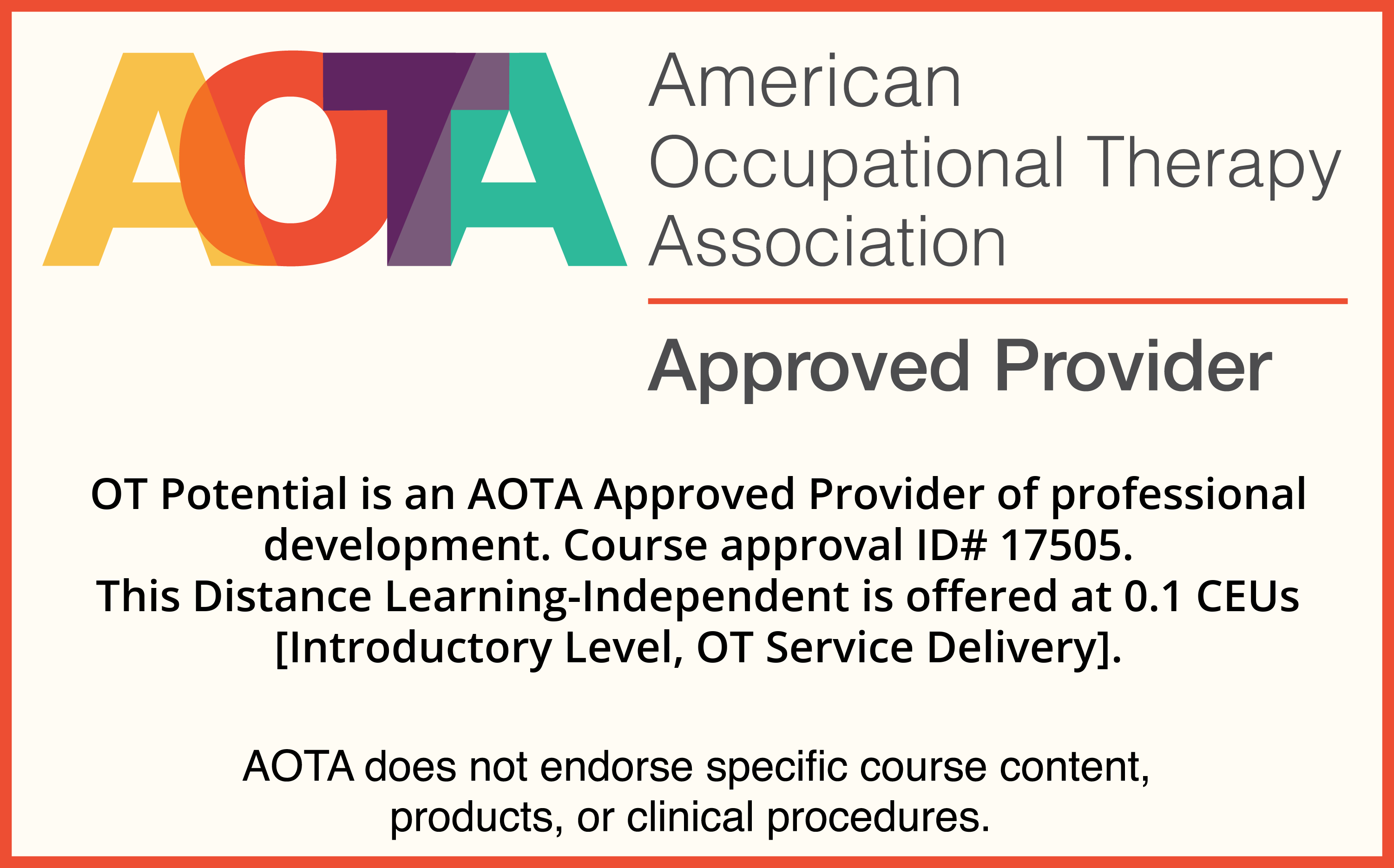
We are proud to be an AOTA Approved Provider and to meet the requirements for your NBCOT renewal.
AOTA Details
AOTA Course ID#: 17505
AOTA CEUs Earned: 0.1
AOTA Delivery Format: Distance Learning-Independent
AOTA Category: OT Service Delivery
AOTA Level: Introductory
NBCOT Details
NBCOT PDUs Earned: 1.25
Instructional Methods, Registration, Special Needs Requests, Cancellation Policy
This course is an independent/self-study course delivered via podcast on one or more of the following platforms: YouTube, Apple Podcasts, Spotify, & Google Play.
If you need accommodations to take this course, please contact us and we will address your needs on an individual basis.
If we cancel a promoted course, event, live stream, or any other paid CEU offering prior to release, and you subscribe explicitly for said offering, you are eligible for a full refund if you did not complete and earn any other CEU quizzes or certificates during your subscription.
If a live webinar is cancelled that you signed up for, our system will automatically generate an email to you and if possible, we will inform you of the rescheduled date. Our most current webinar schedule will be found here.
Audience / Education Level & Course Completion Requirements
Our target audience is therapy professionals who are looking to learn more about this topic. The educational level is introductory. In order to receive a certificate for this course, you must first participate in the podcast/webinar in its entirety. Then, you will need to take the quiz that will accompany the course and earn 75% or higher. If you pass, a PDF certificate will be made available to you via email and download. Quizzes for live (distance learning–interactive) webinars must be completed within 3 days of completing the webinar.
Disclosures
It is the policy of OT Potential to disclose any financial and non-financial interest the provider or instructor may have in a product or service mentioned during an activity. This is to ensure that the audience is made aware of any bias of the speaker.
OT Potential pays guest speakers an honorarium for their participation, either directly or to an institution of the speaker’s choosing at their request. We invite guests whose expertise often comes from practices, programs, or building products in their field. Where a speaker has a financial interest in the subject of a course, we disclose it below so you can weigh it for yourself.
OT Potential’s interest in this topic: We have no financial stake in this topic.
Speaker interests: Ganesh Babulal is an author of Association of Environmental Exposome and Cognitive Function Among Older Adults With and Without Preclinical Alzheimer’s Disease, a study discussed in this course. He conducts grant-funded research on cognition, driving, and dementia risk and has no financial interest in this topic to disclose.
Speakers

Dr. Ganesh Babulal is a Professor in the departments of Neurology and Quantitative Health Sciences at the Mayo Clinic and Director of two laboratories, the DRIVES Project and ARCHES. He is also a research associate at the University of Johannesburg in South Africa.
Dr. Babulal’s research seeks to understand the relationship between cognition and mental health and its impact on instrumental activities of daily living, such as driving, in healthy older adults and those with chronic neurological diseases. It intentionally focuses on healthy aging, protective factors that support brain health, and risk factors for dementia among older adults. The overarching research program among older adults has investigated and connected biomarkers and complex functional outcomes like driving, mental health, and health disparities as risk factors for Alzheimer’s disease and related dementia while also identifying points of intervention, especially for minoritized populations.
He has published eight book chapters and more than 170 peer-reviewed scientific articles in high-impact journals, including Neurology, Journal of the American Medical Association, Alzheimer’s and Dementia, Annals of Neurology, Sleep, and the American Journal of Geriatric Psychiatry. His research has been funded by the National Institutes of Health/National Institute on Aging, Alzheimer’s Association, and BrightFocus Foundation. He serves as an ad hoc reviewer for over 50 journals, serves on the editorial board of 6 journals, and, as the principal investigator alone, has secured over $29.8 million in extramural funding since 2014.
Dr. Babulal holds dual bachelor's degrees (Biology; English), dual master's degrees (Occupational Therapy; Clinical Investigation), and dual doctorates (OTD, PhD in Health Sciences).

Sarah Lyon, OTR/L, is the CEO of OT Potential. Sarah earned her BA from St. Olaf College and her master’s degree in occupational therapy from New York University. Her diverse clinical background spans multiple settings, including critical access, acute trauma, and state inpatient psychiatric hospitals. In 2011, she founded OT Potential to fulfill the industry's need for reliable, high-quality occupational therapy resources and continuing education.
As a recognized content creator, Sarah has collaborated with top healthcare brands like VeryWell Health, WebPT, and MedBridge. She blends her clinical expertise with a talent for creating clear, action-oriented content that empowers practitioners to excel. Passionate about elevating the OT profession, she has been featured on numerous industry podcasts. Sarah ultimately returned to her roots, running OT Potential and raising her family in her hometown of Aurora, Nebraska.