

Starting an OT Practice in 2026
Watch or Listen
(Membership required to take quiz and earn CEUs.)
Also available on



Course Quiz
Choose a CEU plan to take this course quiz!
Plans & PricingCourse Introduction
The landscape of private practice changed forever this year. With Amazon officially adding physical therapy to its marketplace, accessing rehabilitation services is now as easy as ordering a pair of shoes. This shift signifies a massive rise in public awareness of therapy services—but it also brings a new set of challenges for the independent practitioner.
How do you compete with a global giant? How do you meet the “one-click” expectations of modern clients?
In our 2026 “Starting an OT Practice” course, we dive into the complexities of launching and sustaining a practice in this high-tech, high-convenience era. We’ll discuss why easy onboarding is no longer optional, how to leverage the latest AI tools to provide world-class care while run a lean and professional business, and how to position your clinical expertise as a high-value alternative to corporate healthcare.
We are joined by Christopher Gaskins PhD, OTR/L, CSRS, who recently made the leap from “side-hustle” to full-time practice owner. Chris shares his raw, first-hand experience of navigating the ups and downs of launching in this current market, offering a roadmap for OTs who are ready to bet on themselves.
Learning Objectives
You will be able to recognize how solo entrepreneurs can implement integrated systems and technology to facilitate the delivery of high-value, occupation-based evaluations and assessments.
You will identify how solo entrepreneurs can utilize streamlined workflows to support the consistent delivery of evidence-based, world-class occupational therapy interventions.
Agenda
Intro
Discussion
Tell me your entrepreneurship story.
I’ve compiled an entrepreneurship checklist—can I read it to you and get your feedback on anything I’m missing?
On that checklist, what are the most common places where people get stuck?
What systems have you set up that feel key to getting people in the door?
What systems have you set up that feel critical to delivering high-value care?
What factors do you think keep people coming back to you?
What have been your biggest challenges in starting a practice?
What have been the largest rewards of starting a private practice?
Live Q&A
Closing
Supporting Research
Transcript
-
Sarah Lyon
The landscape of therapy private practice changed forever this year with Amazon officially adding physical therapy to its marketplace. Accessing rehab services is now as easy as ordering a pair of shoes. This shift signifies a massive rise in public awareness of therapy services, but it also brings a new set of challenges for the independent practitioner.
Starting a private practice in 2026 raises questions like, how do you compete with a global giant? How do you meet the one click expectations of modern clients? Today, we are diving into the complexities of launching and sustaining a practice in this high tech, high convenience era. We'll discuss why easy onboarding is no longer optional.
How to leverage systems to provide world-class care while running a lean and professional business. We are joined today by Christopher Gaskins, PhD, OTR/L, CSRS. Chris recently made the leap from side hustle to full-time practice owner, and he is going to share his raw, firsthand experience of navigating the UPS and the downs of launching in this current market.
He will offer a roadmap to OTs who are ready to bet on themselves.
Welcome to the OT Potential podcast. I'm your host, Sarah Lyon, OTR/L, and I wanted to let you know that this podcast may qualify as continuing education for you. You are probably listening to this podcast on a free podcast platform, but to gain CEU credit, you will need to be a member of the OT Potential Club, our OT continuing education platform.
You can go to ot potential.com to learn more. Okay, here we go. As I mentioned at the top, we are joined today by Christopher Gaskins. Chris has over 13 years of experience working as an occupational therapist. He developed a passion for Neurore rehabilitation while working at Walter Reed National Military Medical Center from 2011 to 2017.
As his love for neuro rehabilitation deepened, he noticed that there was a shortage of neuro specialists To address this issue, he created Neurosuite in 2019, a neurore rehabilitation company that provides Neurorehab health technology, consultation, and neurorehab education. Chris went all in on this business in May of 2025.
Chris earned his BS in exercise science from the University of South Carolina in 2007, his master's in occupational therapy from Howard University in 2010, and his PhD in neuroscience and cognitive science from the University of Maryland College Park. So without further ado, I will patch Chris into this podcast.
Welcome to OT Potential. Chris, it's so great to have you.
-
Christopher Gaskins
Hey there. Thanks for having me.
-
Sarah Lyon
I am so eager to talk about. starting a private practice. This is something that we try to do once a year on the podcast and every year I am just a little overwhelmed by the complexity of it. This year, one of my friends in my small town is actually starting a OT business, and I've been walking through the stages with her and I'm just reminded how many decisions there are, how.
Kinda emotional. The process is, 'cause you're making so many decisions are really going to affect the trajectory of your business. I am also a business owner. I'm tenure years into owning my own business. And when I think about the. Arc of it. Those decisions at the beginning still feel like the, some of the most important to me, like really, establishing what you wanna do and how you wanna do it.
So I'm just so excited to talk about all those details today. I wanna begin with you and your entrepreneurship story. I know a little bit of the details about starting Neurosuite, but I would just love to hear it afresh. from you and the trajectory that you've been on.
-
Christopher Gaskins
Yeah, sure thing. Again, thanks for having me.
I had no interest in being an entrepreneur at all when I came outta OT school. I was perfectly happy, working as a clinic, therapist, working with the, a larger team. I think what happened is, as you evolve and, your passion develops, you divide like a different mindset, a different way of doing things outside of the norm.
Or what, like a larger system may do. And after some time you just might feel like you're a little kind of boxed in and you just, at some point you have enough courage to try to step out. So that's really what happened, to me, just as I grew naturally in my career and just rehab proclivity and interest in neuro, rehab and neuroscience.
And then I just got to a point where I saw a lot of my peers doing it. My dad always told me, Chris, they can do it. You can too. but then also as we said, like in the intro, I saw like a gap in which, people that had like neurological conditions, they were not getting, a lot of times like very skilled neuro rehab outside of the larger hospitals.
so I started neural suite, in 2019, like in the middle of my, PhD experience. To satisfy two things. One, as a PhD student wasn't making like a lot of money and, wanted a family, so I wanted to have a little more autonomy on earning a little income. But then again, I saw the gap, and I just thought, with my creativity, I had something to bring, to the table to elevate care, like in neuro rehab.
So that's, how we got started.
-
Sarah Lyon
I love hearing when for therapy prac, private practice owners, when part of their motivation is, actually clinical and just wanting to deliver the kind of care that they want to deliver. I know that was one of my motivations in starting a therapy business. Is feel realizing how much the systems affect our day-to-day work and wanting to change the systems.
And a big way to do that is to build your own systems in a therapy practice. Tell me a little bit more about, Neurosuite launched in like 2019. I know you've gone full-time. What was that growth trajectory just over the last, six to seven years?
-
Christopher Gaskins
So even though we started in 2019, I, marked 2025, May, 2025 was like the relaunch or like the real start.
officially we just started in 2019, but I was doing Neurosuite, not part-time, and almost on a p what we call like a PRM basis. not even 10 hours a week, sometimes not even five hours a week. However, although there was like low client volume, it did allow me to get introductory into.
The systems that need to be in place and learning a little bit about, pavement structures, pavement models and, compliance and, things of that nature. But that's where we were from 2019 to 2024. Just low volume, prn seeing clients here, or there, but. When I finished my PhD and I was working as a consultant, I was actually prepared to let Neur suite go actually.
But then for whatever reason, I started getting an uptick in, clients calling and, emailing me. And there was one client I met, she's still working with now, but her husband, amazing caregiver, but very passionate about making sure this wife got the care that he needed. He just, he called, he contacted me and just really emphasized the need for care.
And I was very transparent, said, Hey, like I, I don't have a lot of availability 'cause I'm working as a consultant full-time. I'll do what I can. But, I got in there and started helping and then people still kept on finding neur suites somehow, which was amazing. just, I dunno if that's divine or what, have you, but.
It just got to the point where I just said, maybe, I can take this full time. 'cause there's a need and there's a gap. 'cause every caregiver and patient had the same, or client had the same story and that they didn't feel like they were getting like, specialized neuro like ot. yeah. So that's how we worked from 2019.
But that's what pushed us over the edge in 2024 to make us take it full time, in, 2025.
-
Sarah Lyon
I love the like. Five year on-ramp two full-time. That is my exact timeline as well with starting to OT potential where I worked on it for five years and there is so much to learn when you start a private practice.
if you have the ability to take several years to start as a side hustle and slowly on ramp, that is such a great path and such a reminder for people too. If you are at all interested, to start today. Because, I think one of the best passes, like start today with the goal of in Four to five years being full-time. Like it can just take that long, to slowly learn, see if it's something that is right for you. Is there a need in your area? Yeah, there's just, there's a time for like speed in entrepreneurship and there's a time for a little patience and Testing the waters.
And I love hearing that in your story at OT Potential, we've had this long standing blog post on starting an OT practice, that people can check out later. And one of the requests that we've always of had is to create a checklist for people. So with this episode, one of the things that we'll be putting out is a start.
Private practice OT checklist. it's actually going to come out in its final version on Friday, so anyone listening in the future, will be able to go and check that out. It will be in our handouts, but on this checklist, there's maybe 40 things in the broad categories of. Doing your market research, the logistics of getting your business launched, creating your business entity, getting an address, getting insurance, getting a logo, and then a checklist for, starting your website, maybe getting a couple pictures of yourself for that, F figuring out like your keywords and the, your ideal clients that you wanna find. and from there, deciding on your EMR, we have a couple of checklists around that, and then some around your first customers. I'll be super curious if this feels like a helpful checklist to people. I think when I, look at this checklist, one of the things that jumps out to me is if I could.
I was starting a private practice, I would have a couple thousand dollars set aside. ideally probably three to five to get the logo, get the website, get the business entity, just hit some of those upfront expenses. And then I would also spend quite a bit of time doing like the back of the napkin math on If my pricing is this, how many clients would I have to see and start to like really get the details of that business model. Those are my impressions of this checklist. What do you think of having a checklist like this? Is it helpful? I know you didn't have this in 2019, but what do you think of it for people moving forward?
I
-
Christopher Gaskins
think it's a great start. I wish I had something like this when I started. I wish I found something like this. but no, I think this is, highly useful. I think the, needs assessment is key. Spending a lot of time there from various angles through like just market, research, obviously like Google, like your AI search, but then also finding like a, mentor or just a valid source of information.
I think finding entrepreneurship or rehab entrepreneurship based groups like on, Facebook or Instagram are highly useful for just getting like a general idea of what entrepreneurs are going through. but you have to be careful as far as regarding, as a source of truth, because sometimes, people have incorrect information there.
But being able to find like a, mentor, I think can be important as a part of formulating that needs assessment. But then if you can, talk to the patients, talk to your prospective clients, who are your prospective clients, that significantly helped us shape our model is again, these kind of informal conversations that we had with clients and we started seeing the same themes emerging and that, hey, I don't have a problem finding a pt, but I have issues finding a neuro ot, or I per, prefer to be seen.
At home because it saves my caregiver time or I can work with the things at home that's important to me, that shaped us to be like a, a mobile, in home outpatient company. So I think that's, something I would emphasize like with this, checklist. But I think it's good.
-
Sarah Lyon
I love that.
Or I hear you framing it like. Using your OT skillset to get really curious and ask a lot of questions like, one, hopefully find other entrepreneurs in your state like or doing something similar, and ask them a lot of questions and ask your clients questions. Like even though there's a lot of people in private practice, I don't see one set formula that works.
Like you have to find the formula that works for you as an individual plus your specific. Community, like even with a checklist, it's not a clear path. And even your own idea feels like it might evolve. yeah. Over time for sure. I wanna ask you about what Have been the hardest parts on this checklist.
I think two that stand out to me are credentialing. I honestly don't fully understand that myself, like I've never been through that process. The other one that really stands out to me is just hard, is choosing the right EMR 'cause your EMR. Is more than documentation. It's usually like your onboarding. it has all your, hopefully it has the assessments you want and the clinical support you want, and it will have your billing support.
So it's such an important tool, but there's 30 options and they're all, there's not like one clear right answer there either. Yeah. That's what stands out to me as like the stickiest hardest parts. What. Feels like the hardest logistical part.
-
Christopher Gaskins
The hardest logistical part to me is, understanding what's your payment model or your structure.
Are you gonna be a private pay practice? Are you gonna be insurance base or are you gonna be hybrid? And then it goes back to a needs assessment, really understanding the client population in which you intend to serve. And what are they doing? Or is this a wealthier, perhaps, population that might be able to afford private pay?
Also, considering, what's the estimated number of sessions that you might typically need for this client population, that can help dictate if someone can afford to do private pay versus insurance. Is there a blend utilizing like a hybrid approach, which often is, regarded as kinda like the most flexible and a lot of times preferred.
but if you are going insurance, you really have to have an in-depth or gain an in-depth knowledge of insurance credentialing, or you're gonna go for government or federal, insurance credentialing. So Medicare and like your Medicaid, just state-based or commercials and then commercial insurances.
And if so, for commercial insurances, which ones are used the most in your region? Like for my company, we serve individuals in. In the home, but we work in dc, Maryland, and Virginia, but Northern Virginia, it might be a different, payer mix in that region as opposed to like more Central Virginia where there might be other, some other insurance payers in that are more in front and center.
So you need, you really need to understand that, and it just takes, again, time and asking questions and, doing research and asking professionals in that are already working in that area. But then if you are gonna go do insurance, yeah, you, you have to get credentialed with insurance before you see that client.
And that process might take up to three months or sometimes even more. But you need either yourself or someone to help you. 'cause there's a lot of dedicated admin kind required there, to be able to get those applications through. But that's critical. And then timing, that is the hardest thing. So timing or estimating time it takes to get.
Your company credentialed for, and then also getting your individual therapist credentialed if you're working as an outpatient clinic. Trying to time that and make that in line with hiring and even, how you waitlist your clients. that, that requires a lot of logistics. So if you're new to it, get, support.
There are credentialing agencies that are, that you can utilize that are good.
-
Sarah Lyon
Something that I am personally, logistically confused about is I'm all about the, like back of the napkin math. and if you're private pay, that math is pretty straightforward. You can do that in your head if you're taking.
Not in your head. You can do it on a napkin if you're taking insurance. The math equation gets so complicated. And what, I can't wrap my mind around is that like you probably don't, when you're starting, you probably don't know what, like Blue Cross Blue Shield will reimburse you. Like you don't really know until you get further down the road.
The path because a lot of those numbers are so you get your contract. Yeah. Yeah. Those numbers are obscured to us. So I guess you could start with here's Medicare. Medicare rates are public Medicaid for your state, you have to dig, but those are public. And then just guess like Blue cross Blue Shields in the middle.
And then you have to like factor in a denial rate, but five, it's a lot. I don't even know what, as you're beginning to plan. What do you do with all that complexity? How do you set a good plan? If there's factors we don't know?
-
Christopher Gaskins
Yeah, it can be dizzying. The amount of complexity it is. I think, in that instance we have to make things as simple as possible and give a little bit of a standard deviation, a little bit of a randomness on either side.
your, rate that you're estimating might be like a little bit lower, might be a little bit higher, but keeping things simple, it is a lot. But I think. It's available information, but for example, you can actually get an idea of like how much, Medicare will reimburse you based upon the CPT code you use.
I'm forgetting what the acronym stands for, but Medicare has what they call max, in a, cs. And that essentially, means that this company, manages Medicare for this particular region. So in DC there's a, Mac called Novitas that manages DC Northern Virginia, and, a couple of counties in Maryland near dc.
Then there's a separate MAC called Palmetto, GBA that manages Medicare for all other parts of Virginia outside of Northern Virginia. But yeah, you, should be able to, with a little soothing, you should be able to go to that Mac and you might be able to, use a tool that will actually give you like a.
what the rate is for that CPT code. so I think that is extremely helpful. And, for the commercial insurances, it really depends on your contract, but a lot of times they're, like a percentage of what you would get for Medicare. But again, you really don't know exactly what that is until the contract is done.
But yeah, I think even using that bit information can be helpful in trying to forecast out financially.
-
Sarah Lyon
Yeah, you have to get really nerdy. Pretty early on. We do have, an OT potential is CPT codes blog post, where we have links to where you can find, that information like drilling down to your specific Mac uta, because I'm going to be paid a different rate in Nebraska than you would in Washington DC So you have to get nerdy there. and ideally I've never pursued this, but, understanding what your Medicaid rates in your state too, those should also be public, but are not easily public. You have to do some soothing to get those rates.
-
Christopher Gaskins
And again, I wouldn't try to do it all yourself again.
I would connect with OTs or PTs are doing this
And just, go off of coffee when you can and just get information. But. Over time, you can develop information or get actual support, like again, mentorship I think is key. So you're not doing this alone. 'cause it can be overwhelming, but it can be done.
-
Sarah Lyon
Yeah. I'm gonna get a little bit into the systems you've felt built in the things that you feel have made a difference in your practice. And I just wanna start, at step one of how do patient, how patients. In your door? what's, what are the prime, what are the levers that help someone get to you, and how have you refined that over time?
-
Christopher Gaskins
Yeah, great question. this, the onboarding process for the clients or for me, the most important, system I think. but how do they get to us, having a well designed website with. Appropriate keywords that, search engine optimization, utilizing those keywords, that, will help generate interest, for people looking for the work that you do or something similar.
I think that's, really key and whatever you can do to help that algorithm. Whereas whether it's keeping your social media up to date, doesn't have to be the fanciest post in the world, but just put something out there and just keep on doing it. be. Be consistent. I think that's important.
Obviously, formalizing or creating like relationships with other, healthcare practitioners in the region, whether that be case managers, social workers, PTs, doctors. I think that can be helpful. At Neurosuite, we really adopt a, direct to client, direct to caregiver model. and that we believe that you had, that the clients and the caregivers had the autonomy and the will to find good care.
So our marketing is geared towards them. we don't necessarily seek out, to market like, to like doctors, but we really just focus on the client and giving them the autonomy to make their, decision. But the system, I would say is most important is onboarding. if somebody calls your company and they're interested, Need. in my company, like when someone calls, it's kinda like everything. We stop what we're doing. I imagine like an alarm going off.
-
Sarah Lyon
Yeah.
-
Christopher Gaskins
Because it's, just like alarm. my admin support myself. Everyone stop what we're doing. Read that email that of that interest from that client, potential client.
Pick up the phone. They call, back right away and listen to them, understand what their goals are, what they need, and help them and right away that they're interested. Send them that, that client intake form to get their information to start that process. Now, you had them onboarded, maybe send them like a link to like your social media or maybe like a podcast.
You did some marketing there. But then verify that insurance, but make sure they sign, the appropriate legal, documents. notice the patient responsibility and consent for care and all that good stuff, and then get them scheduled. Fast because another complaint people, say is that it's hard.
It takes them too long to get onboarded and get evaluated. Yeah. So try to push 'em through that process within, we try to do it within one to three days and then get them scheduled. But I think that's, extremely important, that process. 'cause if speed is important, accuracy and, obviously doing things the right way is important, but also speed.
Important. So you need a good efficiency, a good clean system because you can lose a client if you take too long to, to onboard them or, call them back.
-
Sarah Lyon
That feels like the biggest change to me this year. I mentioned at the top that now physical therapy is on the Amazon marketplace like it is Easy to get therapy other places. And, I just did a podcast with Allison Stover who did a study about, accessing therapy services. And the percentage of people like successfully getting scheduled were pretty dismal. It was like only a third of people who made the phone call, actually got scheduled.
oh. I agree. Like alarm bell, if someone contacts you, ring as, move as fast as possible and get them on the schedule.
-
Christopher Gaskins
Yep.
-
Sarah Lyon
and have a system around that. if you can do that well, that feels like a huge one up on your, New therapy practice like that feels so key to dial in.
-
Christopher Gaskins
Yeah. It's very important
-
Sarah Lyon
you're a private practice, OT now, but you are also a neuroscientist, so I am so curious.
As you've been able to design your own systems, what have you put in place to like. Provide high value care. What systems have you built with the actual, like treatment delivery? what have you done differently in your practice than what you were doing other places?
-
Christopher Gaskins
I think it's, to me it's about the, assembly of the team.
I think of my team like as the, as like the Avengers or something. but again, using that market research, I heard a consistent complaint in that. For the clients that we serve, there's a difficulty in finding therapists ahead that were neuro specialized. A lot of them complain of like meal therapy, doing like this regardless of your diagnosis.
Like you're doing like the same thing. So one, I use my duality in that I'm a neuroscientist and OT and I'm very intentional with marketing or, presenting myself as both. I use that as a beacon to attract like these eager and amazing and creative and also very skilled like therapists.
So again, it goes back to marketing and which if you choose to niche down in the area, you need to, express that and, how you present yourself on social media and even how you're out and about like in the community. But for Neurosuite, we purposely, we attract and recruit therapists that have at least one advanced neuro certification.
Or have significant experience with, the neurorehab population. so you might have a certified stroke rehab specialist, certified, neurological, specialist cert, multiple sclerosis, specialist certification, LSVT, big what? Name it. But show me that you have a patch for neuro, or if you don't have that search, show me that you're on the way, you're gonna get one.
But yeah, and that's how we assemble our team. To me, that's given us a, edge that's, shown that's gonna echoed or shown like a vision to our clients that we really do care about you, such that we have developed these skill sets, be able to support you and uplift you as you go through your care.
So hiring, I think hiring is in is important, but I think. You can hire, but also you can attract the people that you want based upon how you present yourself. So again, it goes back to marketing. Even if you're not, even if your company's not fully fleshed out yet, just start marketing.
Get out there, put out there. and it's very important.
-
Sarah Lyon
Yeah, I think most people go into private practice. Because they do want to niche down into something, whether it's pelvic floor, neuro, vision, rehab. And so part of that is marketing. And then part of that is making sure that you're really delivering that really high value care within that, niche.
is there anything you've done clinically like trainings or bot? Yep. Particular technologies.
-
Christopher Gaskins
Yeah.
-
Sarah Lyon
How do you make those decisions for your team?
-
Christopher Gaskins
Totally. So training is a, big one, at least for Neurosuite. so I was able to develop good relationships with a lot of, the rehab technology companies with the various products.
And annually we try to have them come in and speak to us. So we've had Dyna splint come in and, provide like an in-service, my pro. we're working on some other, talks, modus Nova's, another one, bios. Yeah. So I think that's very important. also, we were able to provide our team with, seating and mobility, training for, complex, rehabilitation technology so that we can work with assistive technology practitioners and then, be able to recommend appropriate wheelchairs for clients.
But I think, yeah, training is important. If you can provide, and even if you can't fund it yourself, then there are free trainings all the time.
Let your team know. Drop a little message in the email, say, Hey, this free training's coming up, consider attending. So I think building that culture's important.
Then as far as just, promoting that excellent care. Standardization of care as a CEO or owner, just be willing to share your expertise and, mentor routinely. Check, documentation, create opportunities to connect with your team, to, support them, is important.
And then again, just having kinda like a system of standard, like for example, when we onboard our clients, it's expectation that you, once you're assigned, once a client is assigned to a therapist, it's the expectation that you. The therapist calls them within, one business day to greet themselves and schedule.
So little things like that, might seem minimal to someone that's not a CEO, but it is, it's critical to standardize and care.
-
Sarah Lyon
So yeah, I think those, things are really, useful. Is there anything you do. Like in your EMR, I know you're a intake queue person, where I picture there being lots of like custom forms.
Do you have here's a pathway we wanna do for our MS patients. Here's a pathway for, we're working on it, our stroke patients. Yeah. That's a lot of extra work, but I can see that being ven. Is that the way to go? I don't know.
-
Christopher Gaskins
I think so. we actually just. Put a message out to our team about, three, four weeks ago, giving them opportunity to, hey, if there's assessments that you typically use, let us know.
We can integrate that into like our software, our standard light procedures. but we are working on some things, for example, making sure that each client as a part of the onboarding, process that they have some form A of a, Like a, kinda like a patient, kinda like satisfaction, or a wellness scale, just capturing like their overall their wellbeing.
And then also having patient report outcome measures that are specific to that diagnosis. So like the stroke impact scale or the modified, what was it, the fatigue impact scale, but just having things like that to be more standardized. So yeah, we're working on some of those. Those processes.
-
Sarah Lyon
That's super cool. That's where I get really excited for,
-
Christopher Gaskins
yeah,
-
Sarah Lyon
our private practice owners. 'cause there's so much we can do to optimize care. It feels like the two key inflection points are. Getting people the alarm bell of someone wants to schedule. But then there's this like subtle, more, slightly more subtle one, but just as important is are they going to come back to the next session?
like you want people to come back and do the full course of care. We have horrible dropout rates throughout all of rehab. have you learned. Any systems to help people come back to the next session? do you schedule them right away before they leave? Do you end sessions in a particular way? what keeps people coming back to finish the full plan of care?
-
Christopher Gaskins
Yeah. Honestly, again, I think a lot of that comes back to the skill that therapists that again, we intentionally screen for that when we bring you into the company. but we try to roll out like what we call not a home exercise program but a home activity program. Something that we're encouraging, like all of our therapists to do, to be able to give that out to the client within, anywhere from one to three visits to hold them accountable.
And then also trying to do like a. A patient summary. We haven't released this to the whole team yet, but something I'm still testing. but I've been testing with a couple clients. But this idea that after every session, what the help of responsible use of ai of course, and HIPAA compliant use of ai.
But being able to generate like a one pager, this is how you did today here to do out, so things that we need to work on before our next session. And I've seen that's providing, a lot of value too. So I think those things matter when trying to retain that client and keep them coming back.
Then also once we discharge them as a part of discharge plan, laying out very clearly the plan for when you, when we plan to come back.
Zero to three months, one month follow up, whatever it might be, but lay that out very clearly and then leaving them with the home activity program. And then keeping the door open.
Like we have several clients that are discharged, with, obviously planning to follow back up, but if they need to call us or contact us, we're still there. so building kinda like that culture and that. It's we're not gone, but it's like we see you later.
-
Sarah Lyon
yes.
-
Christopher Gaskins
Helps. Yep.
-
Sarah Lyon
I wanna linger a little bit on your home activity program, because I've been, I've just been thinking about this overall. there's so many tools out there for a home exercise program, which are great, but to me feel limiting as OTs sometimes where we're more geared towards, activities. Are you using a specific program?
To create home activity programs or what does that process look like for you?
-
Christopher Gaskins
so we build it right inside of our software, intake queue. so really just developing a, home activity program or, home exercise program is some call it. But the main structure is usually a description of exercises or activities, oftentimes in the form of a bank.
So it might be four to five activities. We couple that, with a, video or a visual reference or a picture even, so that a client can click on that link and they can see, oh, this is how to do this exercise. And then we'll have a, multiple selection like dropdown. So if there are five activities that's within their activity bank, then they can click on this dropdown.
They simply select what they did for today. Or if today's your day off, select that as your day off. Then a section to indicate any pain today or anything abnormal happened today that you wanna bring to our attention. And then lastly, opportunity that they can click on a link and they can upload a video of themselves doing the exercise, which is underutilized.
So I have to figure out how to Yeah, make that more attractive for clients. but that's the, basic structure. And I've been, again, I've been testing that for a while as a CEO. And then, yeah, we're slowly rolling that out. We want to eventually roll that out as like a requirement for all therapists to be able to make that home activity program.
'cause it holds the clients accountable. Yeah. And it keeps them moving. So we find it'd be pretty important.
-
Sarah Lyon
Yeah. Just as we're talking, I'm like, there are so many decisions both from a like logistical business owner standpoint to. Providing excellent clinical care. I know that the weight of this, and ultimately trying to make a profit, provide for your family, the weight of this can feel crushing for people.
It can be very high stress is, we're talking today. You're like, oh, I can just see the ways the stress, builds up for people. What have you learned? From, like building a support system for yourself and taking care of your mental health.
How have you managed all that?
-
Christopher Gaskins
Yeah, a little harsh, not harsh feedback here, but just honest, feedback.
Hopefully this is not taken the wrong way, but some, sometimes people that are not entrepreneurs, they're not gonna quite understand. so just keep that in mind if you step out, like you might have a need to vent or you wanna talk about Pacific business problem that you're having. but yeah, unfortunately if you have people in your space, you will have some people that are not entrepreneurs and they're still empathetic and caring, understanding.
Yeah, A lot of times if you are not an entrepreneur, there's just some things you're just not gonna quite get or feel or understand the urgency of it. And I think sometimes you can disappoint yourself as an entrepreneur if you go to talk to a confidant and you don't quite get a response that you, wanted.
So unfortunately, sometimes entrepreneurship can be like a little bit lonely. I hate to say that, but it can because two weeks ago, like we got, A big insurance credential. We got clear, like with the big insurer, and it was the biggest scene that's happened for us like in the last two months.
And I was like, woo. Like I literally pulled over on the side of the road and started like I had to yell. I had to let it out because so much was riding on that for our company to expand. At the same time, that's something that I couldn't share, with everyone. 'cause I mean they might be like, oh Chris, that's great, but they wouldn't really understand, like fully get it.
So that goes back to the importance of building like your tribe, your entrepreneur tribe. find a community. next level. OT, for example, is great like on Facebook, but find a community and find people that are going through what you're going through. And I think that's helpful for keeping your mental health in check and also, with a grain of salt.
But I think, although, social media could sometimes be invasive of our thoughts. if we like, like one picture, the next thing you know, like you're seeing 20 images on Instagram or Facebook of this is one thing. Like the other day, like my wife was talking about buying like a new mirror and then next thing you know, I started getting an ad about mirrors.
Yeah. that can be a lot. However, If you use it properly and if you are searching for things about entrepreneurship or tips or things about tech or whatever it might be like that ask that actually can help boost your spirit. if you shape your algorithm to be, motivational and informative.
but again, still take the grain of social media. but then lastly, I would say if you need a therapist, then get one. I think that's helpful. to have someone. Someone to talk to. And if you're spiritual, tap into that. And then I know I do. And then lastly, giving yourself grace. That's the biggest one. Be kind to yourself. 'cause you're, doing things that people have never quite done exactly the way you're doing it. So you're uncharted territory. be kind to yourself and appreciate the, The wins, and then just remember like in being like a nerd right now. But like with neuroplasticity, we learn from our mistakes or our errors, like we can solidify that neur pathway a lot stronger from errors.
So allow yourself to make controlled mistakes, then allow that to push you forward.
-
Sarah Lyon
Yeah, I resonate with all of that to your first point of just it is a unique challenge too. Run your own business. my husband and I kinda separate people into people who have a Stan in a standard job, you're given a sliver of something and you do that sliver really well.
That's like the byproduct of the industrial revolution. That's how we all function, and for therapists, like we deliver the treatment and that's the part that we're accountable for, and that's where we spend our focus. but then as an entrepreneur, you become. To take that full picture, that owner mindset, like now that we see that we can like separate people into that, those buckets of someone who takes that full owner ownership mindset.
It is, it's just unique and not everyone does that. Didn't, and that's okay. Thank goodness for the people who, take care of their sliver. But it's not something that everyone. Relates to. And the other part that I was resonating with was, for myself, like I've just started seeing, like I tried to see an OT as my therapist and that has been the best.
I think all OTs should see another ot. I cannot recommend that enough. 'cause you're seeing someone who like probably resonates with your way of thinking. And even when I like know what I should be doing, like having the knowledge. Is just, that's 5% of the battle, like actually doing the thing.
Been so helpful to have that support system. Do you feel comfortable sharing what some of the biggest challenges have been over the past year? what are the things that have, weighed on you the most as a CEO? I can imagine there's lots of 'em, but what stands out in your mind as some of those big challenges that you've head across?
-
Christopher Gaskins
Yeah, that's a good one. I'll still go back to just making sure things are tight and right with compliance. And also again, with, with that being said, insurance, like we as a CEO, like I made the decision to purposely get a network with all the, major players for insurance because I knew that the clients that we serve, they're using their insurance.
Yeah, that, that required a, in depth level of logistics, so to say. So the hardest thing is again, has been timing. Timing. So estimating from the time you hire a new therapist, how long will it take them to get credentialed so that they can be clear to work with your clients? Is this their first time that they're getting, like a, what we call like an NPI number, or have they were outpatient before?
Like that matters? 'cause as far as like the timeline, factoring all that while trying to manage like a wait list and trying to, if you have a therapist in a new region, trying to figure out the marketing, the timing there has been like, probably the biggest challenge I would say. And, it really just comes from, just effort.
And every day you pick up a little bit more information. Like today, we learn a little bit more information about prior authorizations, which is for some commercial insurances, you have to get a. Even though you're in network, you still have to then get another layer of confirmation or approval called a prior authorization.
to see a client for X amount of visits or to be able to build X amount of units. I just learned something new today. Just didn't know. So again, being grateful with yourself, but that experience has been navigating, it's been a little bit challenging to navigate and the pain point has been, which does happen.
You do get denials, insurance, denials. Sometimes you can't recoup that money. And while I think we've done fairly well, to be honest there, but when it does happen, it still stings a little bit. If you, see like a denial, even if you're able to overcome that denial and make an adjustment and get reimbursement, still hurts.
Because every time that's denial, like you're setting the clock back another two, four weeks even more for you to get paid for the work that you did. So if you think about. Everything from the marketing to onboarding your client, the time you spend up at night, trying to schedule them. And we a mobile practice with driving out to their home, doing the work, lugging your suitcase there, all that.
And then, for your work that you did for that payment to get denied that, St. Stinks.
But it is a reality of being a business owner and just learning how to navigate that space. Work with your billing team to correct that, resubmit the claims, so on and so forth. But I would say that's been most challenging.
-
Sarah Lyon
I think that you're unique in, in this like first year of being full-time. you've scaled already. I know you've alluded to certain parts of that, but could you just walk me through? The timeline of scaling and what that can look like. who are your first like contractors? Is it another therapist? Is it an admin?
What have been those choices for you over the past year? and as you're going through it, would you have done anything differently?
-
Christopher Gaskins
I like how I did it. So we started in May or the relaunch in May, 2025. And it was me one treating. Then today we have two additional PRN therapists in Maryland, four PRN therapists in Virginia.
Just hired a fifth PRN therapist in Northern Virginia, and then a PRN therapist for OT in Charlottesville. so yeah, that's happened. That's a lot fast. That was intentional. 'cause again, I wear this dual hat of being an OTN neuroscientist. And to be able to fully actualize my role or intent, as a CEO and like a neuroscientist.
I want to eventually, or we are, building Neurosuite to, to also have a research and development arm of the company. but to do that I have to shift from patient care. I can't treat, full-time or as much like I used to. so that's for me, that's why scaling has been very intentional because I want.
I wanna support my team and helping them to be the best practitioners that I can through my experiences, but I want them to treat. And whereas I can focus more on the, building of the company and building out the other parts of the company, such as like the research arm. So it was very intentional, but the way that it looked was, again, the marketing projecting, this is who we are, this is what we want, and.
Even without putting out job ads, people just found us from post on LinkedIn or maybe an ad that we ran that had nothing to do with recruiting another therapist, but maybe just an ad about neuroplasticity and someone found us and wanting to join the team. And then when we were intentional about seeking out recruiting, we looked into the network.
I had an opportunity to work with, ADA, who was recently on, OT potential. But we taught together. at a community college. She was like, I think she was the first person I thought of when I said I wanted to hire. The second person I thought of that I wanted to hire was a O. She was in OT school at the time during my PhD program, but she was like, she was a part of my research study.
So look out to your community. it was important just as well as, marketing to find therapists, but you have to make a decision as a CEO of what you want. It's perfectly fine to work as a solo therapist. It's a lot simpler too.
-
Sarah Lyon
Yes,
-
Christopher Gaskins
that's perfectly fine. However, if you want, if you wanna scale, yeah.
Then those are some things you have to have in mind when you do try to scale. I don't know if there's a perfect answer or algorithm to, to find it. More, nothing more than just intentionality.
-
Sarah Lyon
Oh, there's no greater, joy for me in my work than getting to hire people who have complimentary skill sets.
I love that. yes, and that's just, finding what you love as a CEO and leaning into that, I wanted to linger a little bit on hiring an admin. Was that part. Of The journey. And
-
Christopher Gaskins
best decision
-
Sarah Lyon
hiring or contracting for credentialing help? Was that the same person? Were those different?
what did that look like?
-
Christopher Gaskins
Ah, good, point to discuss there. So I look at Neurosuite, and again, we're such an ancy of our growth, but there are certain inflection points where we saw like a pop of like growth, hiring a admin was, was one. So like an admin, Melissa from the company called, for the burbs, very unique name, but like great company.
But hiring her allowed me to offload like a lot of work that I'm necessarily not passionate about, but she is.
And we able to get stuff done and that allowed me as a CEO to focus on more like higher level systems development, marketing, larger thinking. And then one unique thing I did, which I.
Or that opportunity that we had, which I recommend to others, is that, our marketing, we have a, marketing specialist and she actually found us, here's a catch, she's a ot.
-
Sarah Lyon
Oh, cool.
-
Christopher Gaskins
And she does amazing marketing. hi Tina. Giving you accolades here. But yeah, that was another inflection point. at some point I would run, some math.
'cause there's certain. Posts that she made on, social media, certain ads that she developed that literally led to speaking opportunities and new therapists wanting to work for us. so a extreme value there. And I love marketing. I like to get in Canva and make designs and I can,
-
Sarah Lyon
but as a CEO, you don't have the time.
You can't do it all.
-
Christopher Gaskins
So one good book, and I know we talk about books later, but a book called Who Not How I think, by Dan Sullivan. This idea of not thinking about, how you're gonna do everything as a CEO, but who are you gonna delegate it to that's really good at it or can delegate or really passionate about that work.
yeah. And then as far as credentialing, just be very honest with that experience. We had a bad experience for credentialing. since 2019, we've been through three or four different credentialing companies. The major issue that I found was that for the amount of money that we were paying them, I just.
Work was not done diligently or efficiently. And it matters. So if you're, if you have a wait list for an insurer, but you can't go 'cause you're not credentialed yet, that's a blocker. So the best decision I've made was that we paid for Melissa, our admin specialist to get a consultation or training, through next level ot.
She was able to get kinda like one-on-one training on how to do credentialing for Medicare. Since then, we were able to cancel our contract with our prior credential, and she's been able to get us credentialed with so many insurances in a fraction of amount of the time. So resulted in us saving thousands of dollars on the front end, but then also saving us time.
'cause we can now see our clients faster, but also we're learning more, like we able to learn more about the process. If we were working with a credential and we're outsourcing it, sourcing it, they would just tell us, oh yeah, you're not credentialed yet. But being able to bring that in-house, now we know what's going on.
So that's been, that's provided multiples of value on top of multiples. yeah, I would recommend too to everyone out there who not how, who, can join your team.
-
Sarah Lyon
Yeah,
-
Christopher Gaskins
sure, you can do it on your own, but get, some help people passionate. bring them in, make a team.
-
Sarah Lyon
That's so cool to hear.
It feels at some point as you're starting, like you just need to get going and see where the failures are, but the deeper you can dive into each particular area of the process. there's, I'm thinking of credentialing and, we had an episode on negotiating with payers like the more, as you learn more, you can go deeper into the process and understand it more.
The more understanding you have, that's such a point of leverage and a tool for growth and all those things. Just take time. We have three minutes left. I'm going to hit you with two questions during this three minutes 'cause I just wanna know both of them. One, what's been, just one of the most rewarding things about running a practice.
We've talked about the details and how hard it is, what's been one of the benefits, the rewards, and then what's your advice to someone who's at the beginning and thinking about getting going?
-
Christopher Gaskins
The biggest rewards, as a creative 'cause. although my career's become very, healthcare driven and very science based and like logical thinking and all that, naturally I'm a creative.
I just, I love creating things. So to have to do all that work of, OT school and the PhD was so much work and, to not be satisfied, In the world I was currently and be able to take a vision or idea, I had to start it, on literally like on a, two person kitchen table, like in my condo.
And just take that and build it. And I know one day it almost brought me to tears, but I didn't tell my team, but like I had, we were at a training, we were getting trained on, complex rehabilitation technology and everybody had on the neural suite shirts. And on the back of our shirts, there's three lines which stand for our values of, neuroplasticity, compassion, and innovation.
And just in that moment, like I just saw everyone that had those three little signs on the back and it just, did a lot. wow. So being able to take an idea and build a culture around it is powerful. and then also being able to pour into my team and share knowledge I have, I wanna do it more.
But that's powerful. And then helping the client.
-
Sarah Lyon
And what's your one piece of advice to a new entrepreneur? Mine is always, people tend to overestimate what they can do in one year and totally underestimate what they can do in five years. Like you add some time to this effort and it can just be amazing.
-
Christopher Gaskins
Yeah, I would say just do it.
-
Sarah Lyon
Yeah. Yes. Just do it.
-
Christopher Gaskins
And I really, yeah, I really mean that. just do it. 'cause You're not gonna have all the facts. You're gonna, you, as I said earlier, offline, like you have to operate on a, measure of fairly good probability that this idea will work. And if it doesn't work, there are controlled risks or discomfort that I can take, like the beneficial, outweigh the risk, but just go just do it and learn and adapt.
Be flexible. And adjust and be kind to yourself.
-
Sarah Lyon
Chris, I am so thankful that you took this bet on yourself, that you did this and then that you are here today and just willing to share about the journey. And Chris, just thank you so much again for, your time today and for your willingness to share.
I just appreciate it so much.
Thank you for joining us on the OT Potential podcast to earn one hour of a OTA approved continuing education for your time today. You will need to sign in or sign up at otpotential.com. Once you're in the OT Potential Club, you will find a five question post-course quiz connected to this episode. When you pass the quiz with a score of 75% or higher, you will be able to download a PDF certificate that certifies your completion of this.
Okay. I wanna thank you for joining us today and we'll see you next time.
Professions
Contact Hours (CEUs/PDUs)
1 Contact Hour. Released online from Aurora, NE.
This course was designed to meet your continuing education requirements
We designed our courses to meet the requirements for “online” and “independent/self-study” courses. To verify the requirements from your specific state (within the U.S.), check out OT Continuing Education Requirements. If you are outside of the United States and don't see requirements for your specific location on that page, please contact us.
OT Potential courses are presented as live webinars, then released on-demand video and audio via the OT Potential Podcast. Attendance in the live webinar will be indicated on your certificate. Learn more about how our courses help meet live webinar requirements, and OT CEU requirements overall.
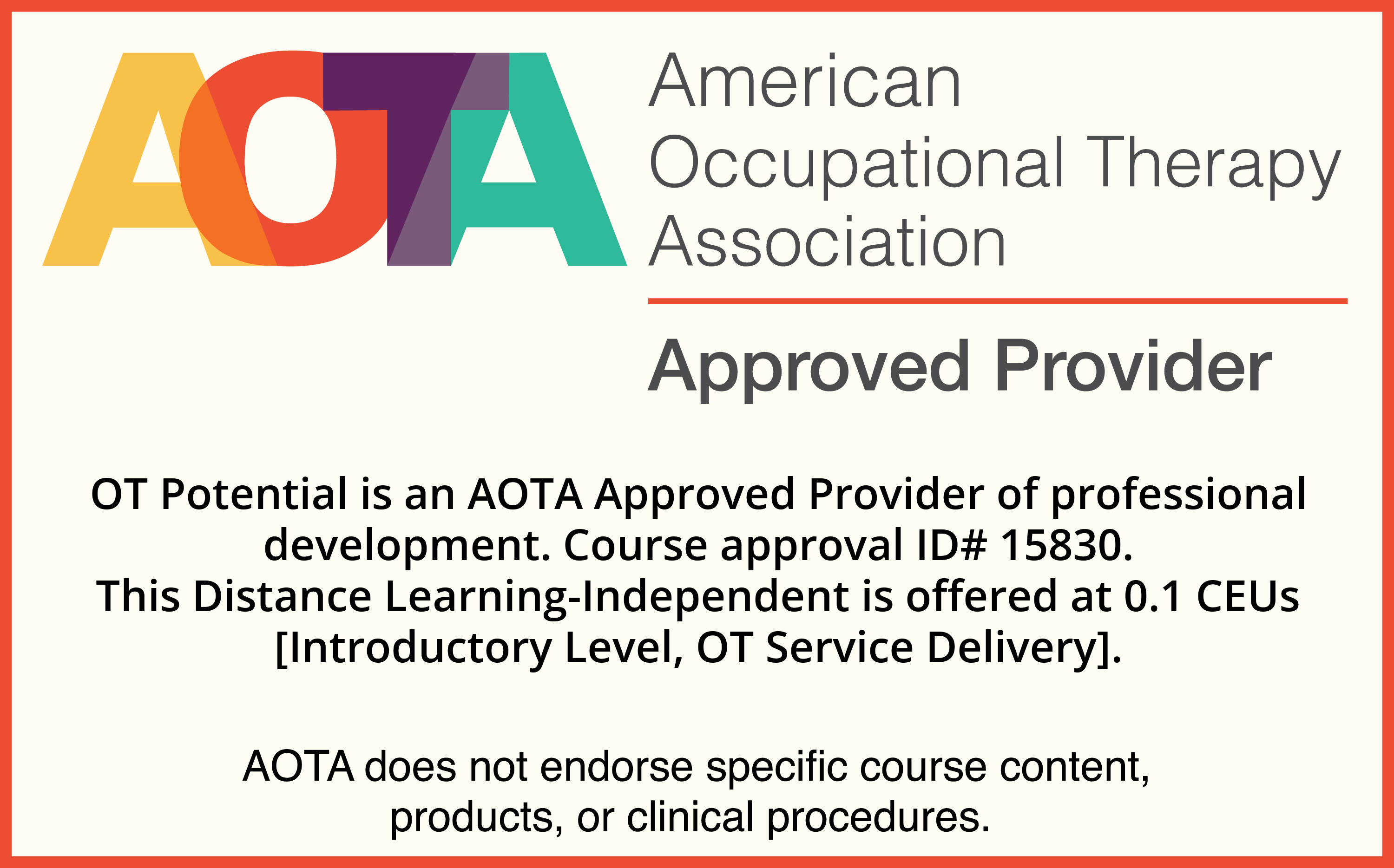
We are proud to be an AOTA Approved Provider and to meet the requirements for your NBCOT renewal.
AOTA Details
AOTA Course ID#: 15830
AOTA CEUs Earned: 0.1
AOTA Delivery Format: Distance Learning-Independent
AOTA Category: OT Service Delivery
AOTA Level: Introductory
NBCOT Details
NBCOT PDUs Earned: 1.25
Instructional Methods, Registration, Special Needs Requests, Cancellation Policy
This course is an independent/self-study course delivered via podcast on one or more of the following platforms: YouTube, Apple Podcasts, Spotify, & Google Play.
If you need accommodations to take this course, please contact us and we will address your needs on an individual basis.
If we cancel a promoted course, event, live stream, or any other paid CEU offering prior to release, and you subscribe explicitly for said offering, you are eligible for a full refund if you did not complete and earn any other CEU quizzes or certificates during your subscription.
If a live webinar is cancelled that you signed up for, our system will automatically generate an email to you and if possible, we will inform you of the rescheduled date. Our most current webinar schedule will be found here.
Audience / Education Level & Course Completion Requirements
Our target audience is therapy professionals who are looking to learn more about this topic. The educational level is introductory. In order to receive a certificate for this course, you must first participate in the podcast/webinar in its entirety. Then, you will need to take the quiz that will accompany the course and earn 75% or higher. If you pass, a PDF certificate will be made available to you via email and download. Quizzes for live (distance learning–interactive) webinars must be completed within 3 days of completing the webinar.
Disclosures
It is the policy of OT Potential to disclose any financial and non-financial interest the provider or instructor may have in a product or service mentioned during an activity. This is to ensure that the audience is made aware of any bias of the speaker.
OT Potential pays guest speakers an honorarium for their participation, either directly or to an institution of the speaker's choosing at their request. We invite guests whose expertise often comes from practices, programs, or building products in their field. Where a speaker has a financial interest in the subject of a course, we disclose it below so you can weigh it for yourself.
OT Potential's interest in this topic: We have no financial stake in this topic.
Speaker interests: Christopher Gaskins is the founder and CEO of Neurosuite, a concierge neurorehabilitation practice that also sells paid consultation services including neurorehabilitation program design and product design.
Speakers


Sarah Lyon, OTR/L, is the CEO of OT Potential. Sarah earned her BA from St. Olaf College and her master’s degree in occupational therapy from New York University. Her diverse clinical background spans multiple settings, including critical access, acute trauma, and state inpatient psychiatric hospitals. In 2011, she founded OT Potential to fulfill the industry's need for reliable, high-quality occupational therapy resources and continuing education.
As a recognized content creator, Sarah has collaborated with top healthcare brands like VeryWell Health, WebPT, and MedBridge. She blends her clinical expertise with a talent for creating clear, action-oriented content that empowers practitioners to excel. Passionate about elevating the OT profession, she has been featured on numerous industry podcasts. Sarah ultimately returned to her roots, running OT Potential and raising her family in her hometown of Aurora, Nebraska.

